What You Learn in 30 Seconds
Soldering flux strips oxide off metal so solder can wet it. IPC J-STD-004D sorts every product into four families by chemistry: rosin (RO), resin (RE), organic (OR), and inorganic (IN), then adds an activity letter and a halide digit, which is how you get a code like ROL0. The classification describes what the flux is made of, not whether it has to be washed off, and confusing those two things is the most expensive mistake in this subject. For most electronics assembly, the real decision is no clean versus water-soluble, and that decision follows from whether you have a wash process you can prove.
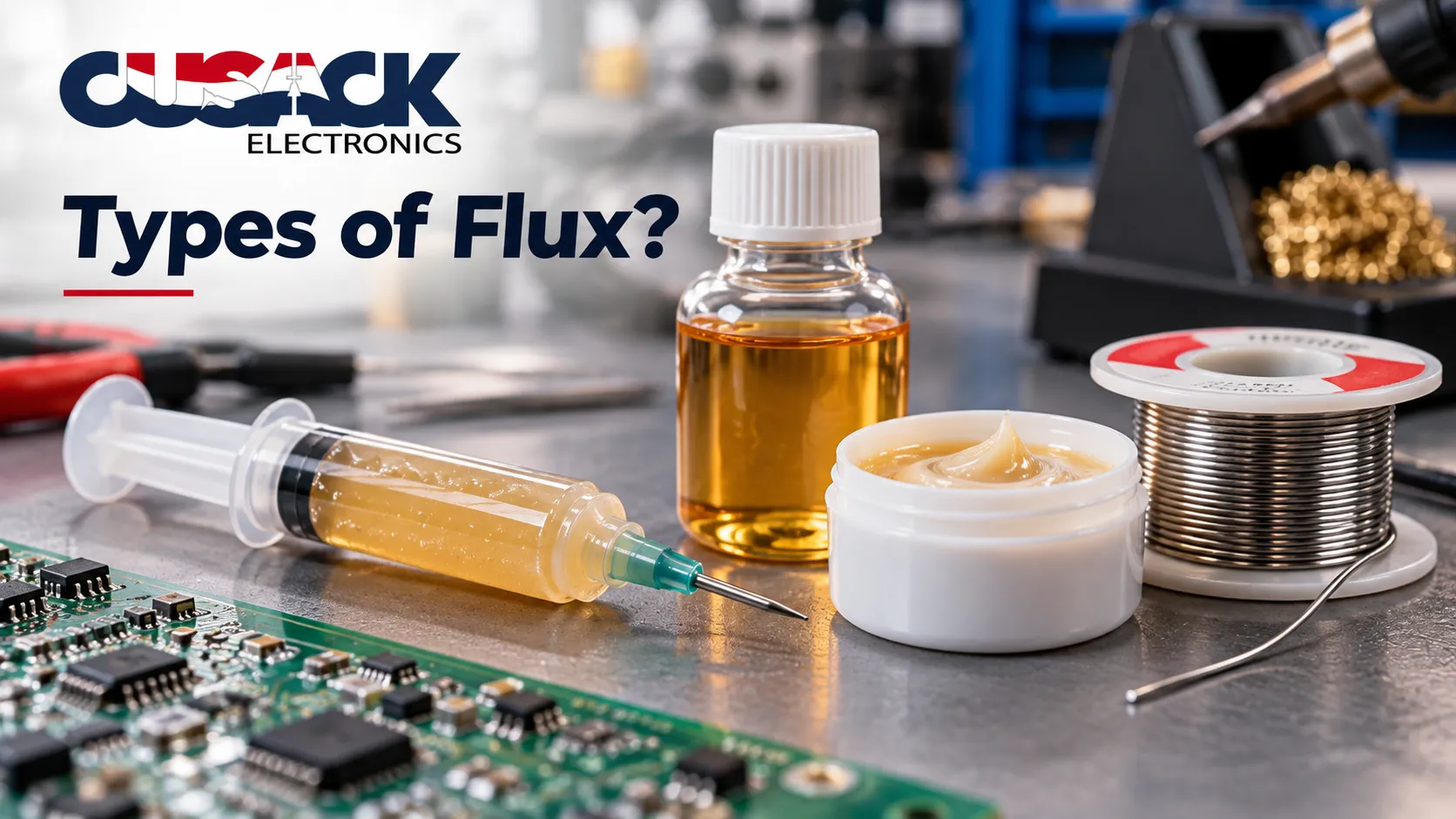
Ask ten engineers to list the types of flux soldering actually needs and you will get ten different answers. Some start with rosin, no clean and water soluble. Some start with R, RMA and RA. Some quote a four-letter code off a datasheet.
All three are describing the same products through different lenses, which is why the types of soldering flux feel muddier as a subject than they really are.
So let me set out the actual structure, then the choice that matters.
I will be straight about my own default first. On almost every board that leaves here, I specify a halide-free no clean.
I would rather change a design than bolt on a wash step I cannot measure. An unproven cleaning process is worse than no cleaning process at all, and there is test data further down this piece to show why.
What Does Flux Actually Do?
Flux is a chemical that removes oxide from metal surfaces so molten solder can bond to them, then protects those surfaces from re-oxidising while they are hot.
Copper grows an oxide layer within hours of being exposed to air. Think of it as a coat of paint, microscopically thin but complete, and solder cannot alloy through paint. Flux dissolves that coat for the few seconds the joint needs and no longer.
It does three jobs at once:
- Oxide removal: the flux activator attacks and lifts the existing oxide layer off pads and leads.
- Oxidation barrier: the carrier blankets the clean metal so it does not immediately oxidise again at soldering temperature.
- Surface tension reduction: molten alloy spreads instead of balling up, which is what solder wetting means.
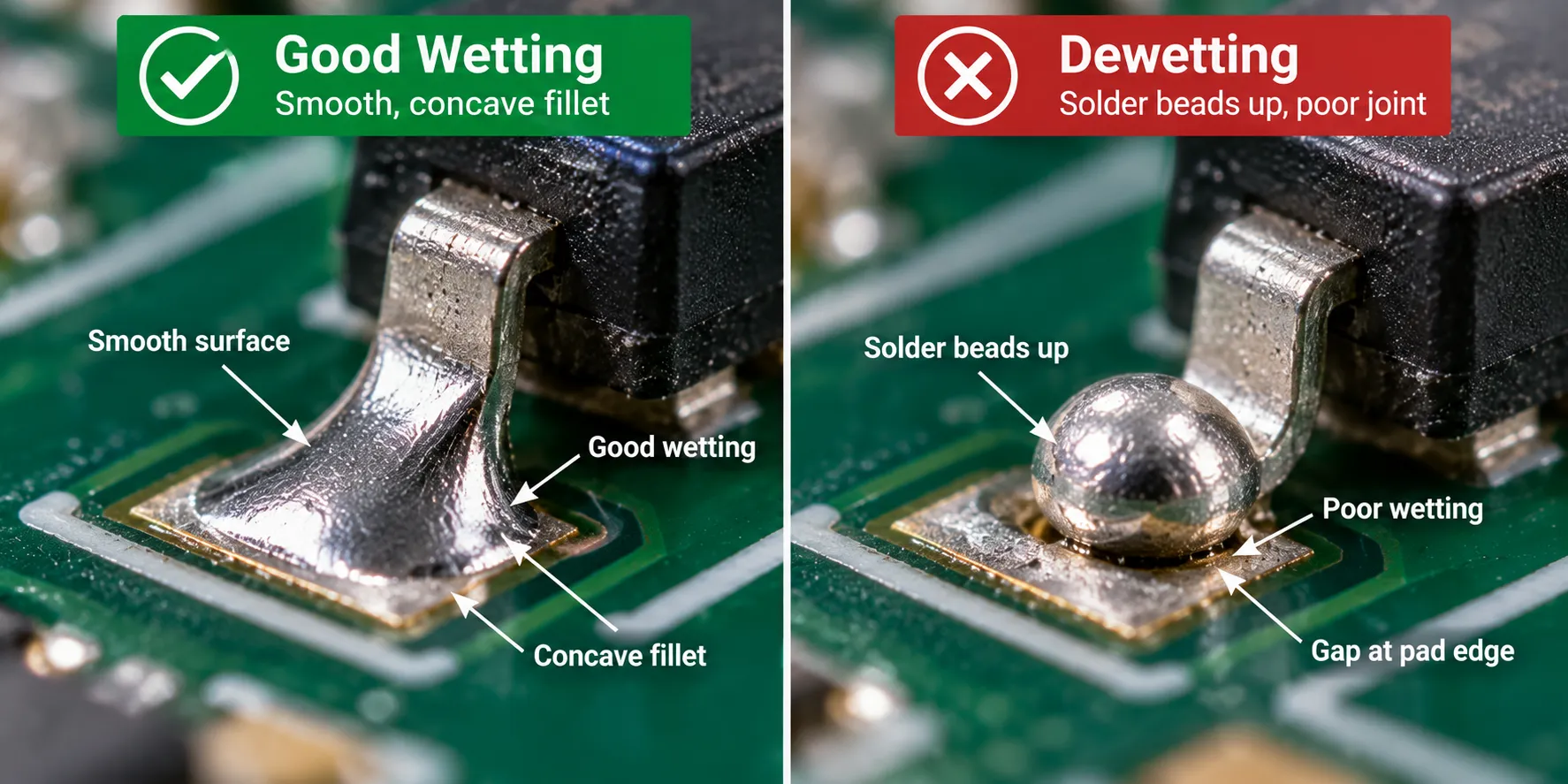
Solder wetting is the measurable version of all this. A well-wetted joint shows a concave fillet that has flowed onto the pad; a poorly wetted one sits as a bead with a visible contact angle, like a water droplet on a greasy plate.
In solder paste, flux has a fourth job nobody lists. It holds parts in place between placement and the oven, which is the only reason a loaded board can travel a conveyor without shedding components.
How Does J-STD-004 Classify Flux?
J-STD-004 classifies flux with a short code built from three things: what it is made of, how active it is, and whether it contains halides.
The current revision is IPC J-STD-004D, issued December 2023, and it supersedes J-STD-004C with Amendment 1 from September 2022. Its Table 3-1 carries the flux identification system and the test requirements behind each classification.
Worth noting, because it affects what you read elsewhere: almost nothing written about flux cites revision D.
Indium Corporation’s own explainer of the classification system was updated in April 2025. It quotes J-STD-004B, issued November 2011, which is two revisions back.
The chain runs 004 in January 1995, A in January 2004, B in November 2011, C in January 2022, then D in December 2023.
Here is Indium’s explainer.
And here is the current revision record.
None of the general articles ranking for flux questions cite the standard at all, which is a strange gap given it is the document that defines the categories they are listing.
The Composition Letters: RO, RE, OR and IN
The first two characters give the chemistry family:
- RO, rosin: refined pine resin, mostly abietic acid, the oldest flux chemistry still in use.
- RE, resin: natural or synthetic resin systems, formulated for more consistent behaviour than raw rosin.
- OR, organic: built on organic acids, with no rosin or resin as the main ingredient.
- IN, inorganic: inorganic acids and salts, aggressive enough for stainless steel and never used on electronic assemblies.
One detail does all the work here. J-STD-004 assigns the letter by the largest weight percent constituent of the flux’s non-volatile portion.
Indium quotes that wording directly from the standard.
So the letter is a composition test. It says nothing about cleaning.
Activity Level and Halide Content
The third character is the activity level, L for low, M for moderate, H for high, assigned from laboratory testing rather than from the recipe.
The copper mirror test is the clearest of those. A flux is applied to a thin copper film on glass, and the grading depends on how much of the film it eats through.
No breakthrough is L, up to half is M, and more than half is H, per Indium’s walkthrough of the test.
The fourth character is the halide digit. A 0 means halide-free, below 0.05 percent by weight.
A 1 means halides are present, and the band attached to that 1 moves with the activity letter.
Low activity caps it under half a percent, moderate runs from half a percent up to 2 percent, and high sits above 2 percent, as AIM Solder sets out.
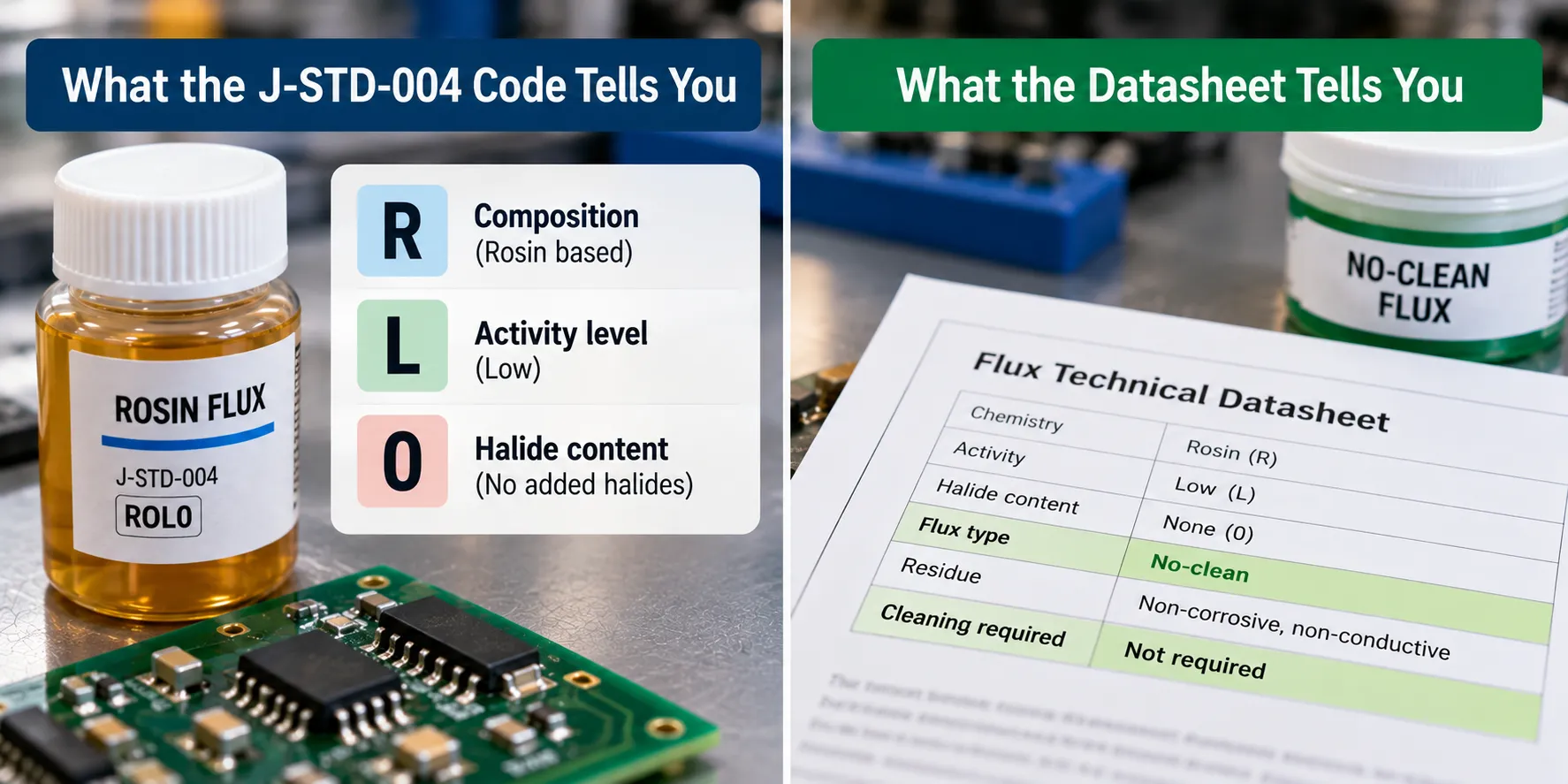
So ROL0 reads as rosin, low activity, halide-free. ORH1 reads as organic, high activity, halides present.
One trap on datasheets. Halide and halogen content are not the same measurement: halide is measured by ion chromatography on the bulk flux, halogen by oxygen bomb testing on the residue left after soldering. AIM flags the distinction, and the two numbers get quoted interchangeably all the time.
What Are the Main Types of Flux Soldering Uses?
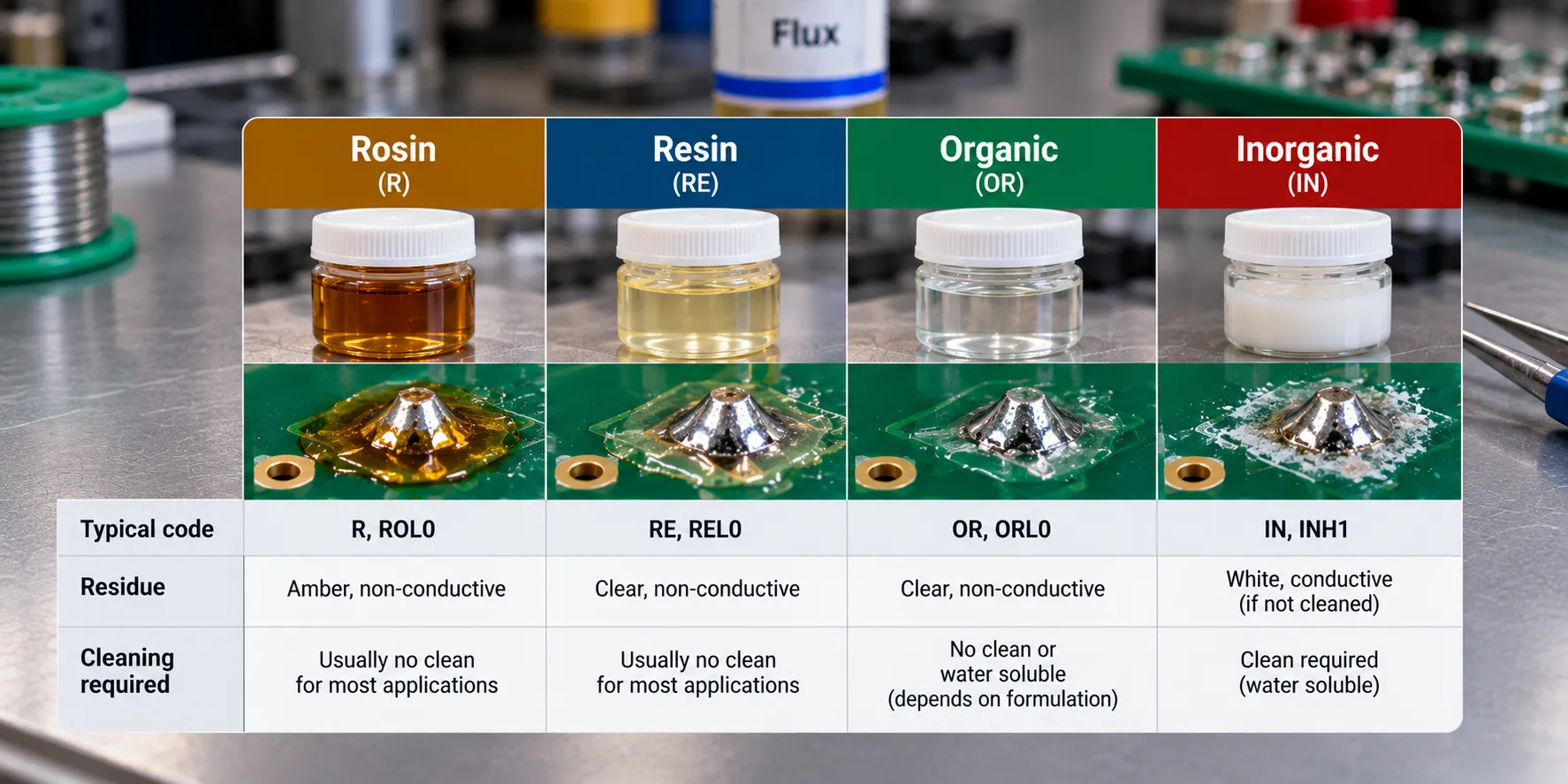
The four types of flux soldering uses map directly onto those composition letters, and in electronics only three of them appear on a real production floor.
| Family | Typical codes | Residue | Cleaning | Where it is used |
|---|---|---|---|---|
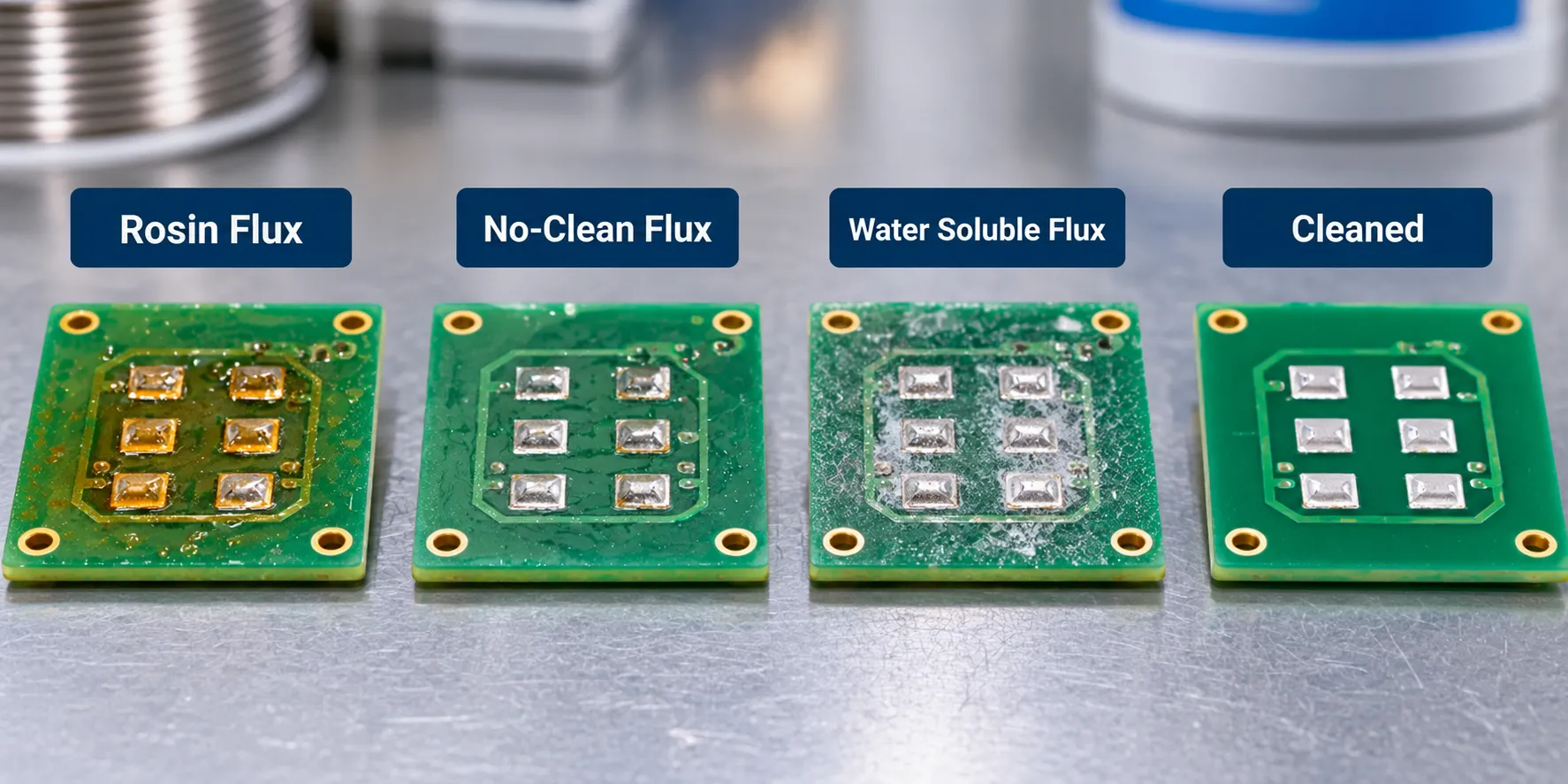
| Rosin | ROL0, ROL1, ROM1 | Hard, amber, tacky when warm | Usually, with solvent | Rework, legacy and high reliability work |
| Resin | REL0, REM1 | Clear, low, encapsulated | Normally none | Most modern no clean paste and liquid flux |
| Organic | ORL0, ORM1, ORH1 | Varies widely by product | Depends entirely on the product | Water soluble process lines and some no clean |
| Inorganic | INH1 | Corrosive salts | Mandatory | Plumbing and sheet metal, not electronics |
Rosin Flux and Rosin Flux Types
Rosin flux is pine resin, collected and refined, and it works because abietic acid turns mildly acidic at soldering temperature and goes inert again as it cools.
Rosin flux types are still usually named with the pre-J-STD-004 labels, and those labels survive on datasheets next to the newer codes:
- R, non-activated: rosin alone, very mild, only useful on clean and easily soldered surfaces.
- RMA, rosin mildly activated: a small activator addition, the long-standing default for high reliability hand work.
- RA, rosin activated: a substantially larger activator load, strong enough for oxidised leads, and its residue is not something to leave on a board.
The reason rosin persists after a century is the residue. Once cooled it is a hard, non-conductive shell that physically seals whatever activator did not get consumed, which is also the principle every no clean product borrows.
No Clean Flux
No clean flux is formulated so the residue it leaves is safe to leave in place, by keeping the solids content low and encapsulating any unspent activator in the rosin or resin as it cools.
That encapsulation is the whole mechanism. Indium describes the resin as rendering the remaining activator inert, and that only holds if the flux got hot enough to complete the reaction.
Which is the quiet condition attached to every no clean product. It is designed around a full thermal profile, so it behaves as advertised through reflow soldering and much less predictably under a hand iron, where heating is local and brief.
Low solids cuts both ways too. Less residue to worry about, less active chemistry in reserve, so no clean gives you a narrower process window on oxidised parts.
Water Soluble Flux
Water soluble flux uses organic acids as the activator and is designed to be washed off completely with deionized water after soldering.
It is far more aggressive than any no clean product, which makes it the honest answer to badly oxidised leads, long-stored stock and heavy through-hole work. The residue left behind is ionic, hygroscopic and genuinely corrosive if it stays.
That is not a flaw. It is a trade: you buy oxide-stripping power and you pay for it with a mandatory wash step, DI water, waste handling and the floor space all of that occupies.
Skip the wash on a water soluble board and you have not saved a process step. You have shipped a corrosion mechanism.
Inorganic Flux
Inorganic flux is built on acids and salts such as zinc chloride, and it exists for metals that organic chemistry cannot touch, like stainless steel and galvanised sheet.
It has no place on a circuit board. The residue is conductive and corrosive, and no cleaning process will reliably recover a populated assembly from it, which is why it belongs in plumbing and fabrication rather than anywhere near electronics.
Why Organic Flux Does Not Mean Water Soluble
An OR classification tells you the flux is built mainly on organic acids. It does not tell you the flux needs washing.
This is the single most common error in writing about flux classification, and it is worth being blunt about. Organic acid flux and water soluble flux get used as synonyms almost everywhere, including by people who should know better.
They are not synonyms. OR is a composition call, decided by weight percent. Washability is a product property, decided by formulation.
Indium makes the point against its own category: OR-classified no clean materials exist, leave minimal residue, need no cleaning, and are chosen specifically because they stay clear of in-circuit test probes and work under conformal coating.
The commercial cost of getting this backwards is real. I have seen an OR designation on an incoming datasheet read as a cleaning requirement, which turns a no clean line into a budget request for an aqueous wash system nobody needed.
The reverse error is worse. Treat a genuine water soluble OR product as self-managing because somebody read “no clean” into the family letter, and the board leaves with active acid on it.
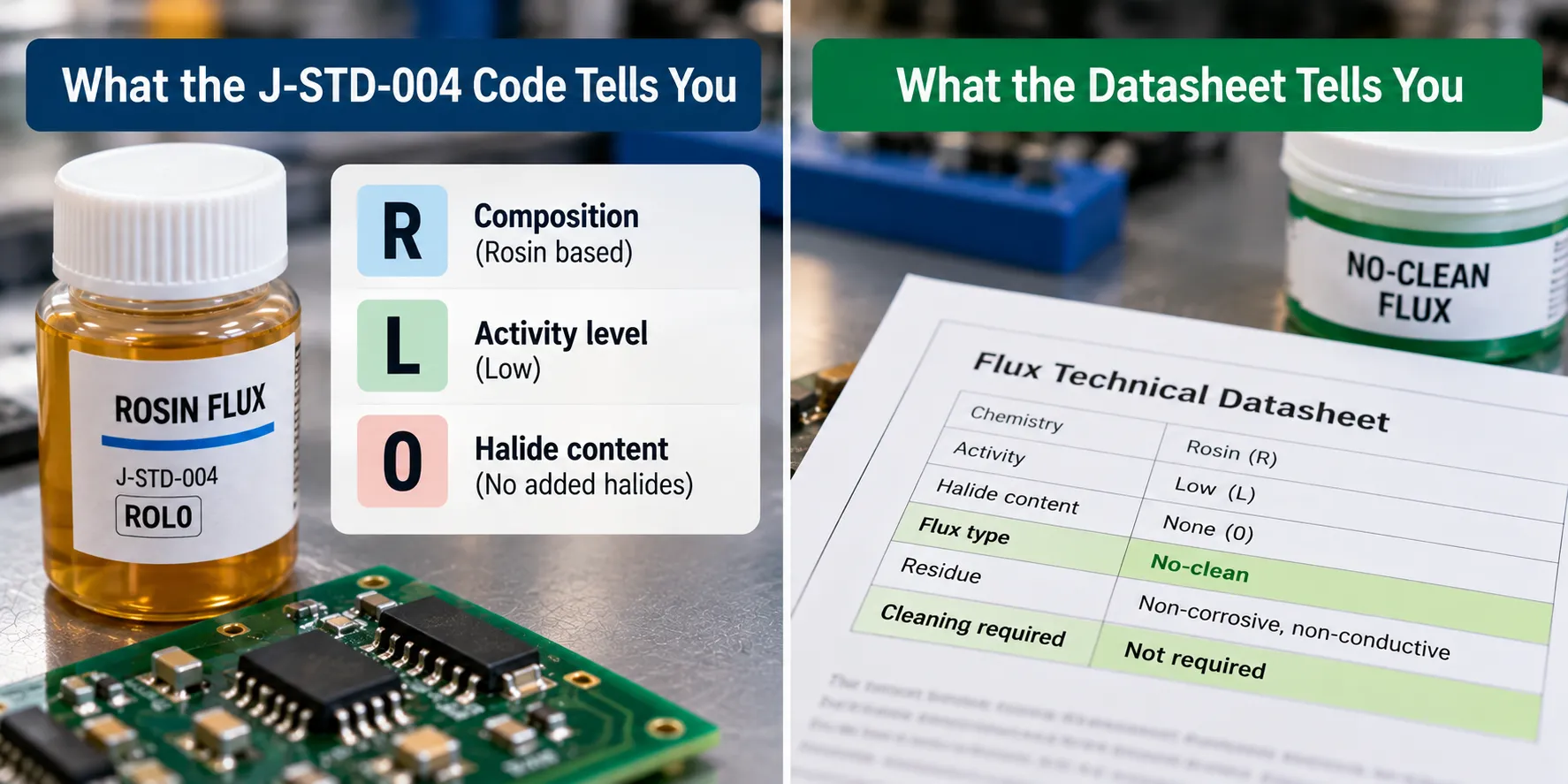
Read the product datasheet for the cleaning requirement. Read the code for the chemistry. They answer different questions.
What Forms Does Flux Come In?
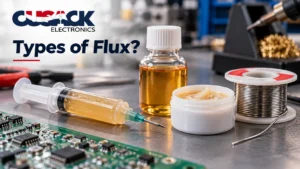
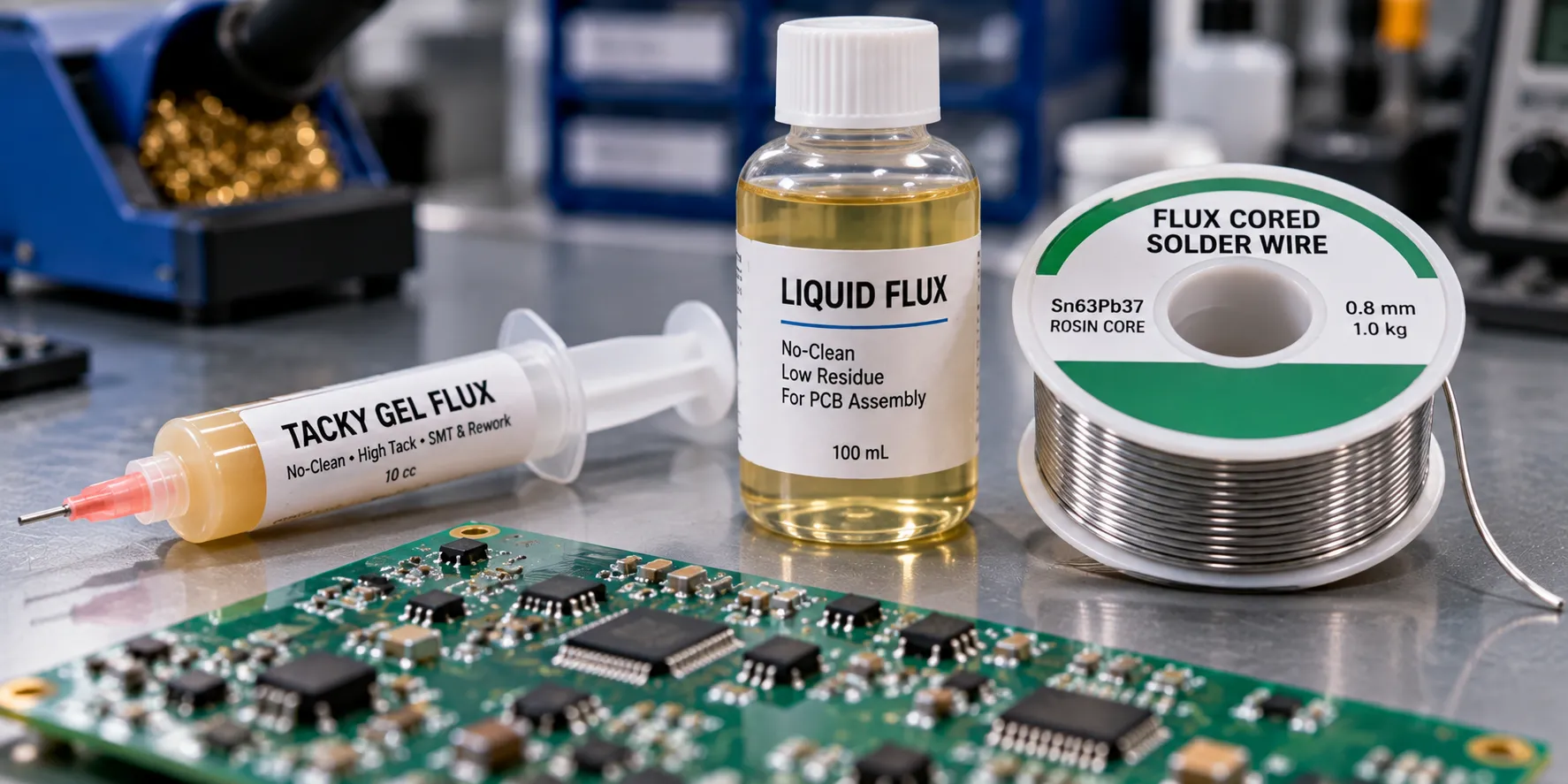
The same chemistry is sold in four delivery formats, and the format is usually set by the process rather than by the choice of flux:
- Solder paste: alloy powder suspended in a flux vehicle, printed through a solder paste stencil and melted in reflow soldering.
- Liquid flux: sprayed or foamed onto the underside of a board ahead of wave soldering, typically at low single digit solids.
- Tacky gel flux: high viscosity, dispensed from a syringe, which is what holds a replacement part during BGA assembly and rework.
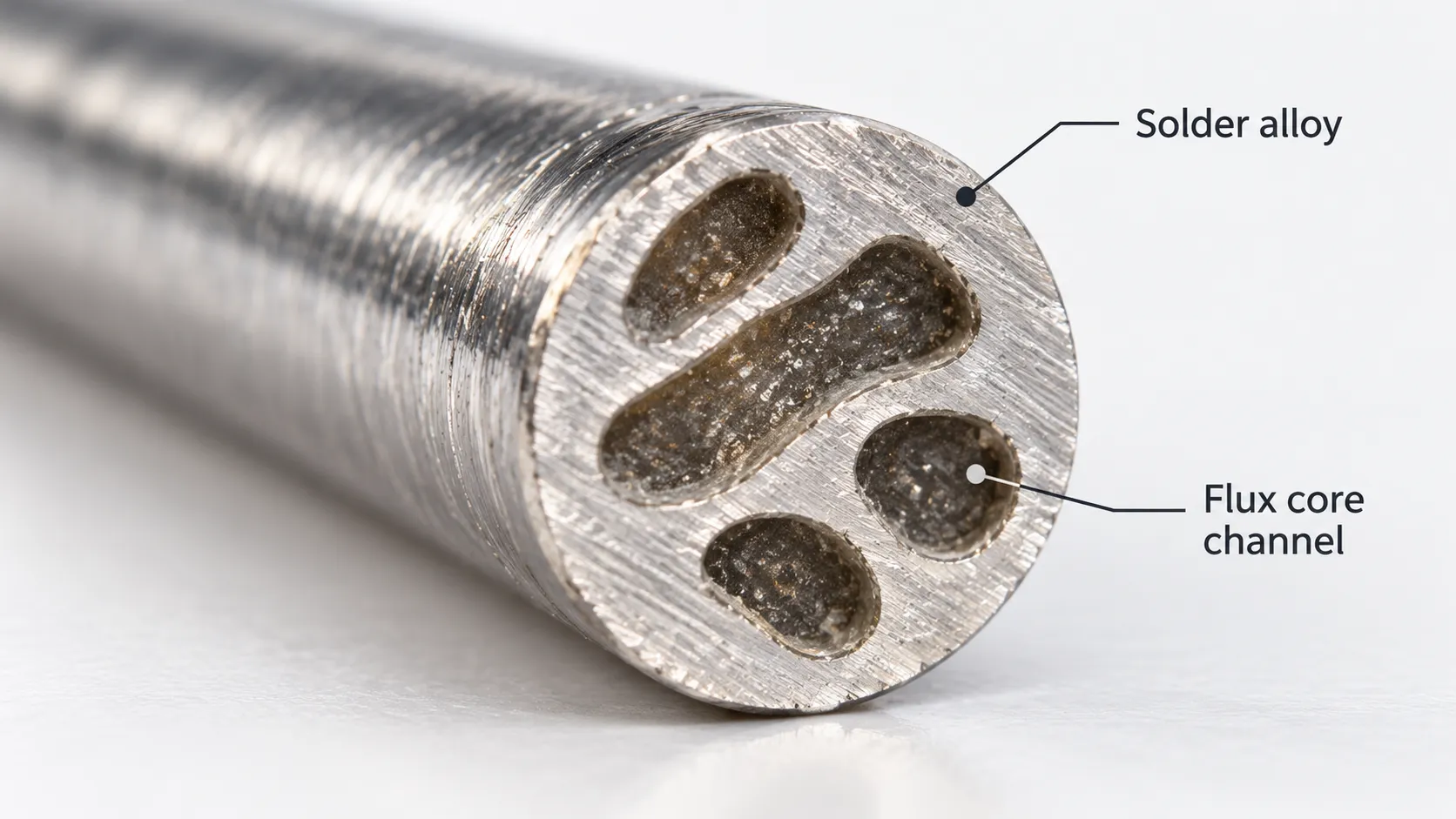
- Flux core solder: wire drawn with flux running through hollow channels in the core, so the flux arrives at the joint with the alloy.
Flux core solder is the one most people meet first, usually as rosin core wire on a bench. The core is typically between 1 and 3 percent of the wire by weight, which is enough for a clean pad and nowhere near enough for an oxidised one.
That is the practical limit of flux core solder. On anything that has sat in a drawer, the cored wire alone will not strip the oxide, and a separate gel or liquid flux does the real work.
What Happens to Flux Residue After Soldering?
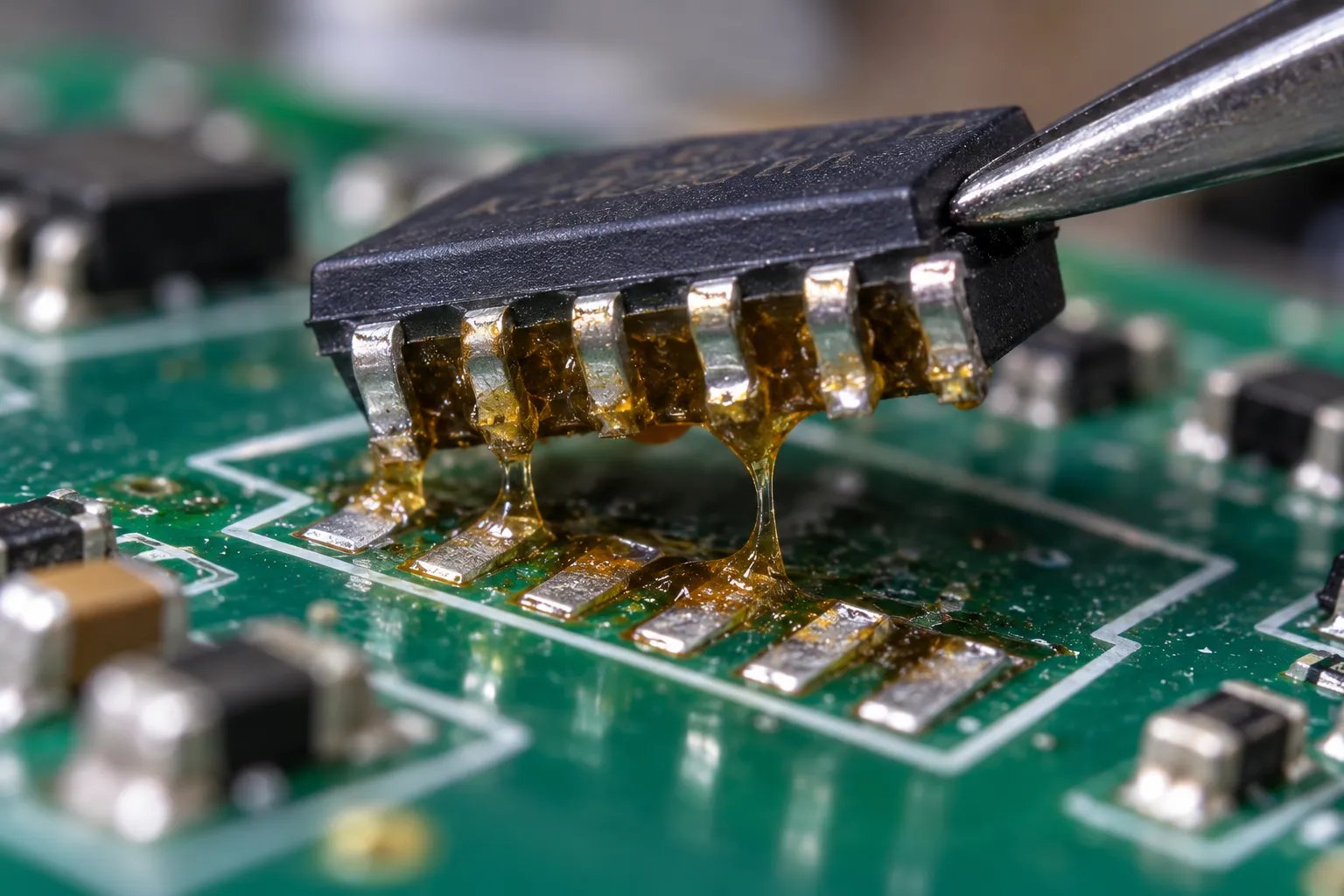
Flux residue is whatever is left on the board once the solvent has evaporated and the activator has done its work, and whether it has to come off depends on the product, the assembly and the service environment.
IPC J-STD-001 is the standard that governs this on the assembly side rather than the materials side. The current revision is J-STD-001J, issued 2024, superseding J-STD-001H from 2020.
The measurement that decides arguments about residue is surface insulation resistance.
Surface insulation resistance, or SIR, is the electrical resistance across the gap between two conductors, measured while the board is held hot and humid. A low SIR reading means current is finding a path where the design does not want one, usually through ionic contamination that has absorbed moisture.
Here is the finding that changed how I think about cleaning, and it comes from real hardware rather than a datasheet.
Eric Camden of Foresite tested recovery options for assemblies that already had trapped no clean residue under bottom-side parts. Three cleaning processes were compared against a SIR threshold of 1.0 x 10^8 ohms, measured at 85 degrees Celsius and 85 percent relative humidity.
The results are in his paper published by IPC.
| Cleaning process | SIR at 96 hours | SIR at 168 hours | Result |
|---|---|---|---|
| Deionized water only | 1.22 x 10^6 ohms | 1.00 x 10^6 ohms | Failed |
| DI water plus heated saponifier | 3.24 x 10^7 ohms | 1.00 x 10^6 ohms | Failed |
| DI, saponifier and 190 PSI steam | 5.22 x 10^9 ohms | 2.94 x 10^10 ohms | Passed |
| Bare panel control | 4.14 x 10^9 ohms | 3.12 x 10^10 ohms | Reference |
Read the first two rows again. Both processes washed the boards. Both left them two orders of magnitude below the threshold.
Only the process that forced chemistry underneath the components with high pressure steam recovered the assemblies, and that process landed level with a bare panel that had never been soldered at all.
The mechanism Camden describes is a dam of partially activated flux forming between leads, holding residue in a place that neither visual nor microscope inspection reaches. Dendrites grow there later, in service.
The field half of the same work recovered 49 of 50 power units, with the single failure traced to unrelated component damage.
Treat those numbers as a documented case rather than a current benchmark. IPC’s published copy of the paper carries no date, so I would not quote it as this year’s state of the art.
The conclusion I draw from it is a process rule, not a chemistry one. A partial wash of a no clean board can leave it measurably worse than no wash at all, because water mobilises an activator it cannot carry away.
So cleaning after soldering is a commitment, not a precaution. Either leave a no clean residue alone as the product intends, or run a process you have validated with SIR data on your own boards.
That is also how IPC J-STD-001 frames it. The cleanliness requirement attaches to a qualified process, not to the material you bought.
On the bench I use isopropyl alcohol for rework. I will say plainly that isopropyl alcohol spreads no clean residue around as readily as it removes it, unless you are wicking it up rather than only wetting it.
How Do I Choose Flux for Soldering Electronics?
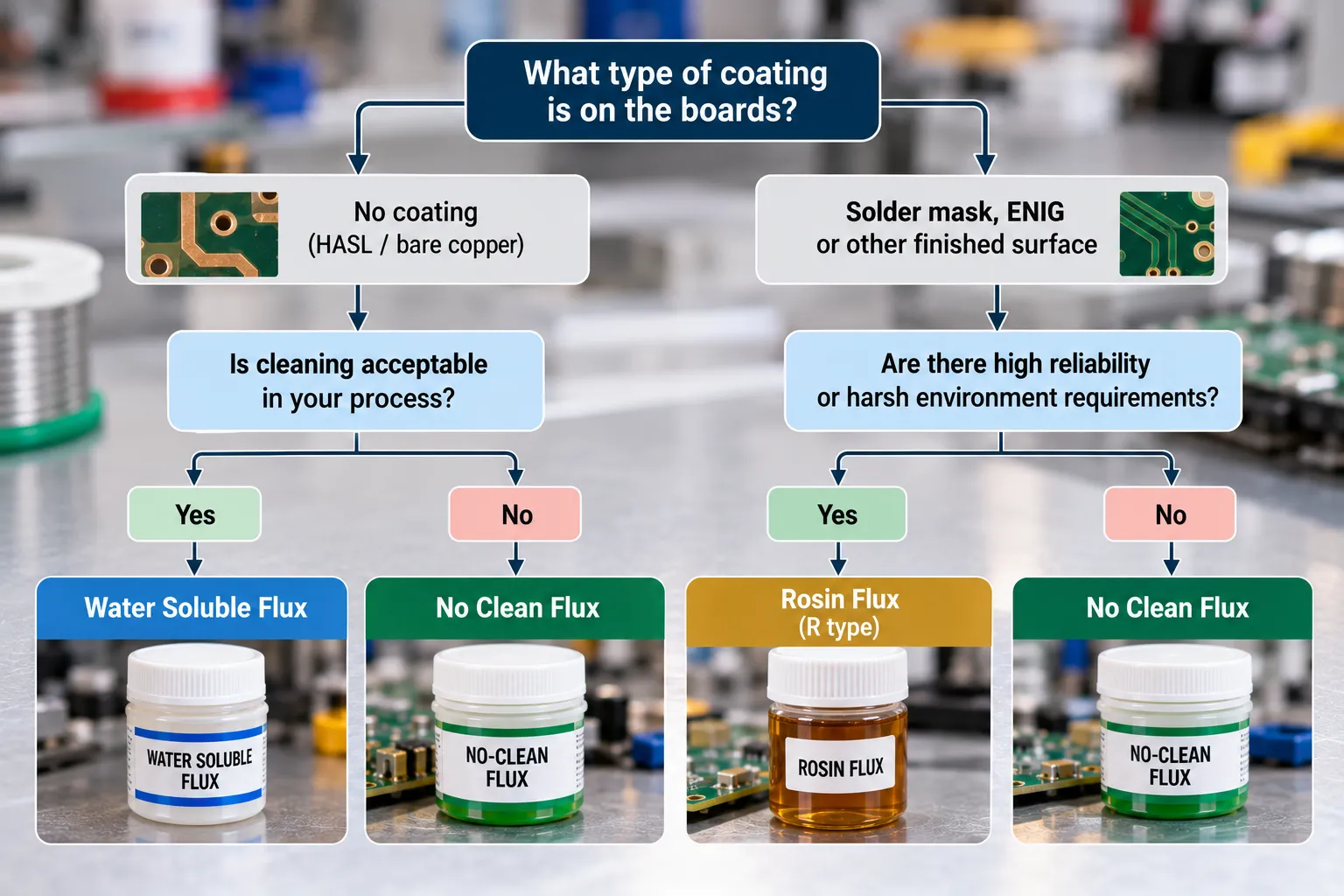
Choose flux for soldering electronics by working backwards from what happens to the board after the joint is made, not from the flux specification itself.
These are the triggers that actually decide it:
- A coating or potting compound is going on. Clean first. Covering active residue seals a problem under the conformal coating where nothing can reach it.
- The board goes on a bed-of-nails fixture. Residue on test pads reads as a false open, so a low residue no clean earns its place during PCB testing.
- Fine pitch, high voltage or humid service. Specify halide-free, and get SIR data on your own board rather than trusting the category.
- No validated wash process on site. No clean, and respect what that means, because the partial wash is the worst of the three options.
- Oxidised leads or long-stored components. Higher activity, which in practice means water soluble and a committed cleaning step.
- High volume through-hole on a wave line. Low solids liquid flux, and the spray setup matters as much as the chemistry.
The cost side is simpler than it looks. A wash process is capital, DI water, waste handling and labour, and it shows up in PCB assembly cost on every board thereafter, not once.
Which is why the sequence matters. Decide the cleaning process first, then pick the flux that fits it. Doing it the other way round is how assemblies end up with chemistry the line cannot support.
The Bottom Line on Flux Selection
- Four families, set by J-STD-004D: rosin, resin, organic and inorganic. Inorganic never touches electronics.
- The code describes chemistry. The datasheet describes cleaning. Organic does not mean water soluble.
- No clean works by encapsulating unspent activator, which assumes a full thermal profile, so it is less dependable under a hand iron.
- Water soluble buys oxide-stripping power in exchange for a mandatory deionized water wash.
- A half-finished wash of a no clean board can test worse than leaving the residue alone.
- Pick the cleaning process first. The flux follows from it.
For the wider picture of where flux sits in a production line, I have walked through the whole sequence in my guide to electronic PCB assembly.
Frequently Asked Questions
What do the letters in a flux code like ROL0 mean?
ROL0 breaks into three parts. RO is the composition family, rosin. L is the activity level, low, assigned from laboratory testing including the copper mirror test.
The final 0 means halide-free. A code like ORH1 reads the same way: organic composition, high activity, halides present above the threshold for that activity level.
Does flux core solder need extra flux?
On clean, fresh pads, no. The flux running through the core is usually 1 to 3 percent of the wire by weight, which is sized for surfaces that are already solderable.
On oxidised leads or long-stored stock, the cored wire will not strip enough oxide on its own, and a separate gel or liquid flux does the real work.
Can I leave no clean flux residue on the board?
Yes, that is what the product is designed for, provided the flux reached a full thermal profile so the activator was consumed and encapsulated. Two situations change the answer: a conformal coating or potting compound going over the residue, and an in-circuit test fixture needing clean probe contact. Hand soldering also heats too locally to rely on the encapsulation.
Is water-soluble flux better than no clean flux?
Neither is better in general. Water soluble strips oxide far more aggressively, which makes it the right answer for oxidised leads and heavy through-hole work, but its residue is corrosive and the wash step is mandatory. No clean needs no cleaning and gives a narrower process window. The deciding question is whether you have a validated wash process.
What is the difference between soldering flux and solder paste?
Solder paste is powdered solder alloy suspended in a flux vehicle, so it carries both the metal and the chemistry in one printable material. Flux on its own carries no alloy.
That is why paste is used for surface mount printing, while separate flux is used for rework, wave soldering and anywhere the solder arrives by another route.
Is rosin flux safe to breathe?
No. The UK Health and Safety Executive regards rosin-based solder flux fume as one of the most significant causes of occupational asthma in Britain, and states that once the asthmatic effects are fully developed they are permanent and irreversible.
That is HSE’s own guidance for electronics soldering, which calls for fume extraction and asks whether a rosin-containing flux is needed at all.
HSE’s COSHH guidance note for soldering with rosin-cored solder, reference SR20 of March 2025, goes further and gives a figure: under 0.05 mg per cubic metre of solder fume as an 8-hour average is achievable with controls properly applied.
Follow your own jurisdiction’s occupational health rules on this, not a flux datasheet.
How long does soldering flux last?
Shelf life depends on the product and the format, and the only reliable figure is the one printed on the container. Liquid flux and solder paste both change as solvent escapes and the activator ages.
Paste has the shortest usable life of any format once it has left refrigeration. Record the date a container is opened, because opened and unopened shelf life are different numbers.