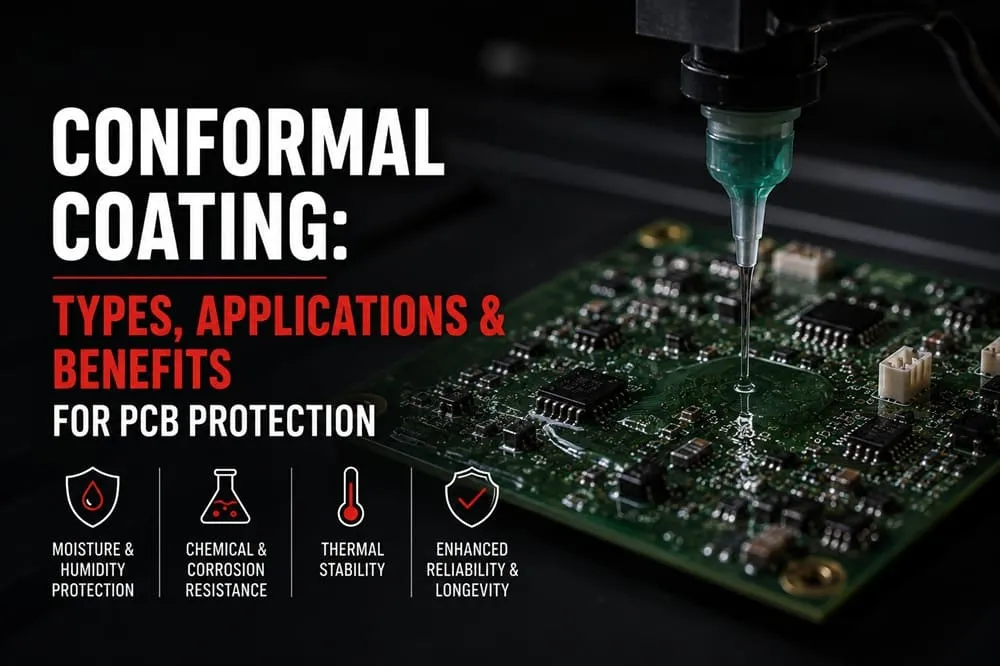
A PCB that works perfectly in a lab can fail within months in the field if it’s exposed to moisture, dust, or vibration it wasn’t protected against. Conformal coating is the thin protective layer that stands between a bare circuit board and the environment it actually has to survive in — and choosing the right type matters just as much as applying it correctly.
This guide covers what conformal coating is, the main types available, how it’s applied, and when it’s worth adding to your product.
What Is Conformal Coating?
Conformal coating is a thin protective polymer film applied directly to a populated PCB, “conforming” to the shape of the board and its components. Once cured, it creates a barrier against moisture, dust, chemicals, and temperature extremes — protecting the board from the environmental stress that causes corrosion, shorts, and premature failure.
Conformal coating PCB applications are especially important for products used outdoors, in industrial settings, or anywhere humidity, vibration, or contaminants are a concern.
Why Use Conformal Coating for Electronics?
Conformal coating for electronics solves a specific set of reliability problems that are otherwise difficult to design around:
- Moisture protection — prevents condensation and humidity from causing corrosion or short circuits
- Dust and contaminant resistance — keeps conductive dust and debris from bridging components
- Vibration and mechanical stress resistance — adds a layer of support that helps prevent solder joint fatigue
- Chemical resistance — protects against exposure to fuels, solvents, or cleaning agents in industrial environments
- Extended product lifespan — reduces field failures, which is especially valuable for products with long deployment periods
Main Conformal Coating Types
Not all coatings perform the same, and choosing among the different conformal coating types depends heavily on your product’s operating environment.
| Coating Type | Key Properties | Best For |
| Acrylic | Easy to apply and rework, moderate protection | General-purpose electronics, cost-sensitive applications |
| Silicone | Excellent flexibility, wide temperature range | High-heat environments, vibration-prone products |
| Urethane | Strong chemical and abrasion resistance | Harsh industrial or outdoor environments |
| Epoxy | Very durable, but difficult to rework | Permanent protection where rework isn’t needed |
| Parylene | Extremely thin, uniform, excellent barrier properties | High-reliability, medical, or aerospace applications |
Acrylic Conformal Coating
Acrylic conformal coating is one of the most widely used types, valued for being easy to apply and just as easy to remove for rework or repair. It offers solid, general-purpose protection against moisture and dust, making it a common default choice for consumer and general industrial electronics.
Silicone Conformal Coating
Silicone conformal coating stands out for its flexibility and ability to withstand extreme temperature swings without cracking. It’s often used in automotive and industrial applications where boards experience significant vibration or thermal cycling.
Urethane Conformal Coating
Urethane conformal coating offers strong resistance to chemicals, solvents, and abrasion, making it a popular choice for boards exposed to harsh industrial environments. It’s more difficult to rework than acrylic, but the added durability is often worth the tradeoff for demanding applications.
Epoxy and Parylene Coatings
Epoxy conformal coating provides very durable, permanent protection, but its difficulty to rework makes it best suited for products that won’t need future repairs. Parylene, applied through a vapor deposition process rather than spraying or dipping, produces an extremely thin, pinhole-free barrier prized in high-reliability medical and aerospace applications where failure simply isn’t an option.
Conformal Coating Application Methods
How a coating is applied matters almost as much as which type you choose. Common conformal coating application methods include:
- Spray coating — fast and efficient for medium to high-volume production, though it requires masking sensitive areas like connectors
- Brush application — precise and useful for small runs, repairs, or touch-ups, but slower and less consistent at scale
- Dip coating — submerges the entire board for full, even coverage, well suited to higher-volume production
- Selective coating — uses automated dispensing to apply coating only to specific areas, avoiding the need for masking connectors or components that must stay exposed
Selective coating has become increasingly popular for electronic conformal coating in production environments, since it reduces masking labor and material waste compared to full spray or dip methods.
Where Conformal Coating Is Used
PCB conformal coating shows up across a wide range of products and industries, including:
- Industrial automation and control systems, where boards are exposed to dust, moisture, and temperature swings on a factory floor
- Automotive electronics, which must withstand vibration, heat, and occasional exposure to fluids
- Outdoor and marine equipment, where humidity and salt exposure are constant threats
- Medical devices, where high reliability and resistance to cleaning chemicals are critical
- Aerospace and defense systems, where failure isn’t an option and extreme conditions are common
Products built with PCB assembly destined for these environments often specify conformal coating as a standard part of the manufacturing process, rather than an optional add-on.
Choosing the Right Conformal Coating for Your Product
Selecting the right coating comes down to a few key questions:
- What environment will the product operate in? Extreme heat or vibration points toward silicone; harsh chemicals point toward urethane.
- Will the board need rework or repair after coating? Acrylic is far easier to remove than epoxy or parylene.
- What’s your production volume? Higher volumes often justify investment in selective or dip coating equipment.
- Are there masking requirements? Connectors, test points, and heat sinks typically need to stay coating-free.
Working through these questions with your manufacturing partner during the design phase — rather than after the board is already built — helps avoid costly rework or coating failures down the line.
Final Thoughts
Conformal coating is one of the most cost-effective ways to dramatically extend the reliability and lifespan of a PCB, especially for products facing moisture, vibration, dust, or chemical exposure. Choosing the right type and application method for your specific environment is what separates a coating that actually protects your product from one that just adds cost without real benefit.
If you’re specifying conformal coating for an upcoming product, reach out to our team to discuss the right type and application method for your environment.