Modern products demand tolerances measured in thousandths of an inch, materials that perform under real-world stress, and parts that fit correctly the first time. That level of accuracy is exactly what precision CNC machining delivers — and it’s why it’s become the backbone of manufacturing across industries ranging from electronics to aerospace.
This guide covers what precision CNC machining involves, the different services under that umbrella, and how to know if it’s the right process for your part.
What Is Precision CNC Machining?
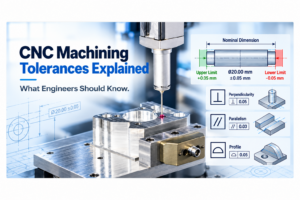
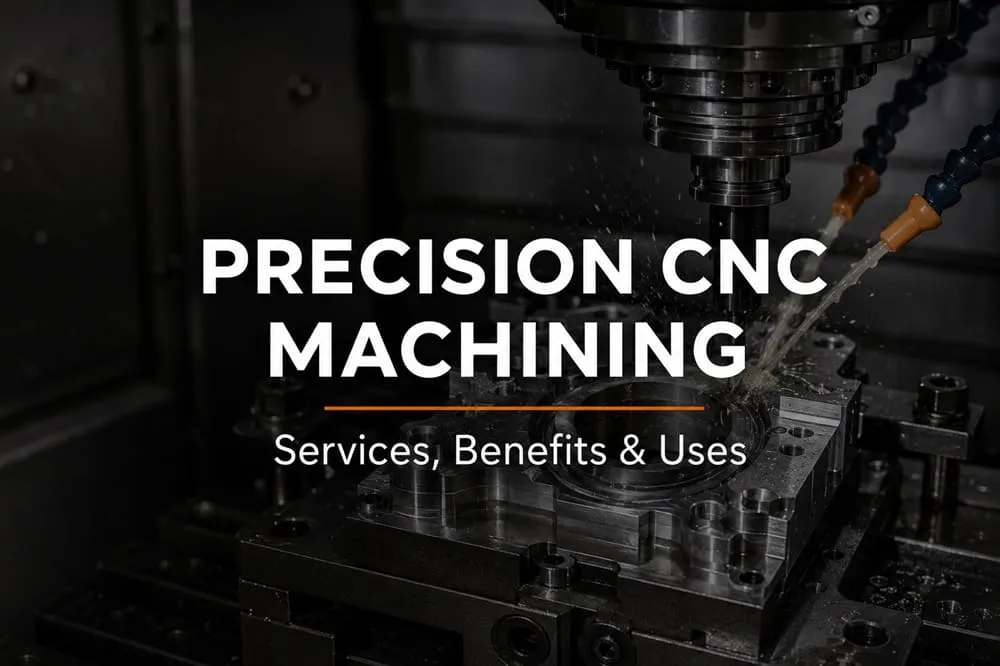
Precision CNC machining uses computer-controlled cutting tools to remove material from a solid block — known as a workpiece — to create a part that matches an exact digital design. Unlike manual machining, CNC (Computer Numerical Control) systems follow programmed instructions with extremely tight tolerances, producing consistent, repeatable results across a single part or an entire production run.
This precision matters most in applications where even small deviations can cause a part to fail — think enclosures that need to seal properly, brackets that must align perfectly with other components, or connectors that require exact dimensional accuracy.
Core Precision CNC Machining Services
Not all CNC work is the same. Here’s a breakdown of the main service types typically offered under precision CNC machining services:
CNC Milling Services
CNC milling services use rotating cutting tools to remove material from a stationary workpiece, making them ideal for parts with flat surfaces, slots, pockets, and complex 3D geometries. Milling is often the go-to process for enclosures, brackets, and custom housings.
CNC Turning Services
CNC turning services rotate the workpiece against a stationary cutting tool, making this process ideal for cylindrical parts — shafts, bushings, and round connectors. Turning typically achieves excellent surface finishes and tight diametric tolerances.
Prototype CNC Machining
Prototype CNC machining allows engineering teams to produce functional parts in the actual material they’ll use in production, rather than 3D-printed approximations. This is critical for testing fit, function, and durability before committing to full production tooling.
High Precision Machining
For parts with extremely tight tolerance requirements — common in aerospace, medical, and specialized electronics applications — high precision machining uses advanced multi-axis equipment and rigorous quality control to hold tolerances that standard machining can’t reliably achieve.
Custom CNC Machining and Custom Machined Parts
Off-the-shelf components don’t always fit a specific design. That’s where custom CNC machining comes in — producing custom machined parts built to your exact specifications rather than adapting your design around a stock part.
Common reasons companies turn to custom machining include:
- A standard part doesn’t meet dimensional or performance requirements
- The application needs a specific material not available in off-the-shelf parts
- Low to mid-volume production doesn’t justify tooling for injection molding or casting
- Design changes are still expected, and machining allows faster iteration than hard tooling
Materials Used in Precision Machining Services
Precision machining services work across a wide range of materials, each suited to different applications:
| Material | Common Properties | Typical Applications |
| Aluminum | Lightweight, corrosion-resistant, easy to machine | Enclosures, brackets, heat sinks |
| Stainless steel | High strength, corrosion-resistant | Fasteners, structural parts, medical components |
| Brass | Good conductivity, machinability | Connectors, fittings, decorative parts |
| Engineering plastics (Delrin, Nylon) | Lightweight, low friction | Bushings, gears, insulating components |
| Titanium | High strength-to-weight ratio | Aerospace, medical implants |
Choosing the right material depends on mechanical requirements, environmental exposure, and cost targets — something worth reviewing with your machining partner before finalizing a design.
Industries That Rely on Precision CNC Machining
Precision CNC machining supports production across a wide range of industries:
- Electronics and industrial automation — enclosures, brackets, and structural components for control systems
- Consumer products — custom housings and mechanical parts requiring a polished finish
- Aerospace and defense — tight-tolerance components that must perform reliably under stress
- Medical devices — precision parts requiring strict quality documentation and traceability
- Energy and utilities — durable components built to withstand harsh operating environments
Machined parts often pair with other finishing processes — like powder coating — to add corrosion resistance and a finished appearance to bare metal components.
Choosing a Precision CNC Machining Partner
When evaluating precision CNC machining services, look for a provider that offers:
- Multi-axis equipment capable of complex geometries, not just basic milling and turning
- In-house quality inspection and measurement equipment
- Experience across a range of materials relevant to your application
- Support for both prototype runs and scaled production
- Design feedback before machining begins, so tolerance or material issues are caught early
A machining partner who also offers mechanical design services can review your part for manufacturability before cutting begins, reducing costly redesigns later in the process.
Quality Control in Precision CNC Machining
Consistency is what separates true precision CNC machining from basic metal cutting. A reliable machining process includes:
- First article inspection — verifying the first part off a production run matches design specifications before continuing
- In-process measurement — checking dimensions at key stages, not just at the end
- Calibrated measurement equipment — coordinate measuring machines (CMMs) and precision gauges to verify tight tolerances
- Documentation and traceability — especially important for regulated industries like aerospace and medical devices
Without these checks, even well-programmed CNC equipment can produce parts that drift out of tolerance over the course of a production run — which is why quality control matters just as much as the machining process itself.
Final Thoughts
Precision CNC machining remains one of the most reliable ways to produce accurate, durable parts — whether you need a single prototype or a full production run. Understanding the different services available, from milling and turning to prototype and high-precision work, helps you choose the right process for your specific part and application.
If you have a part that needs precision machining, get in touch with our team to discuss your project and material requirements.