THE 30-SECOND VERSION
- EMS vs ODM vs OEM is a question about three roles in one supply chain, not three competing vendors. The OEM owns the product. The EMS provider builds it. The ODM designed it before you arrived.
- If you are trying to work out which one you are, you are almost certainly the OEM. That is the brand owner seat, and it is the one most readers of this page occupy without knowing the label.
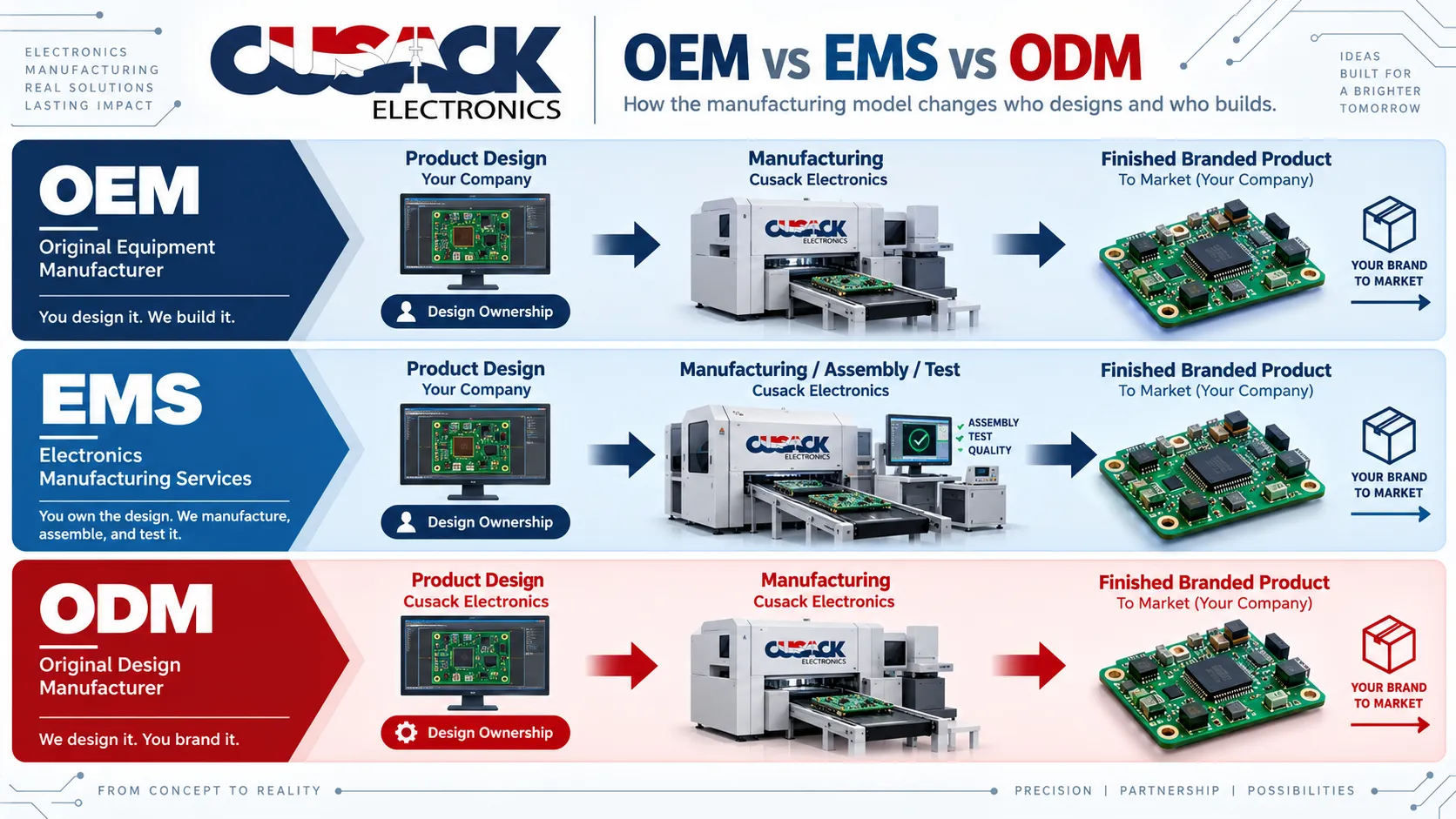
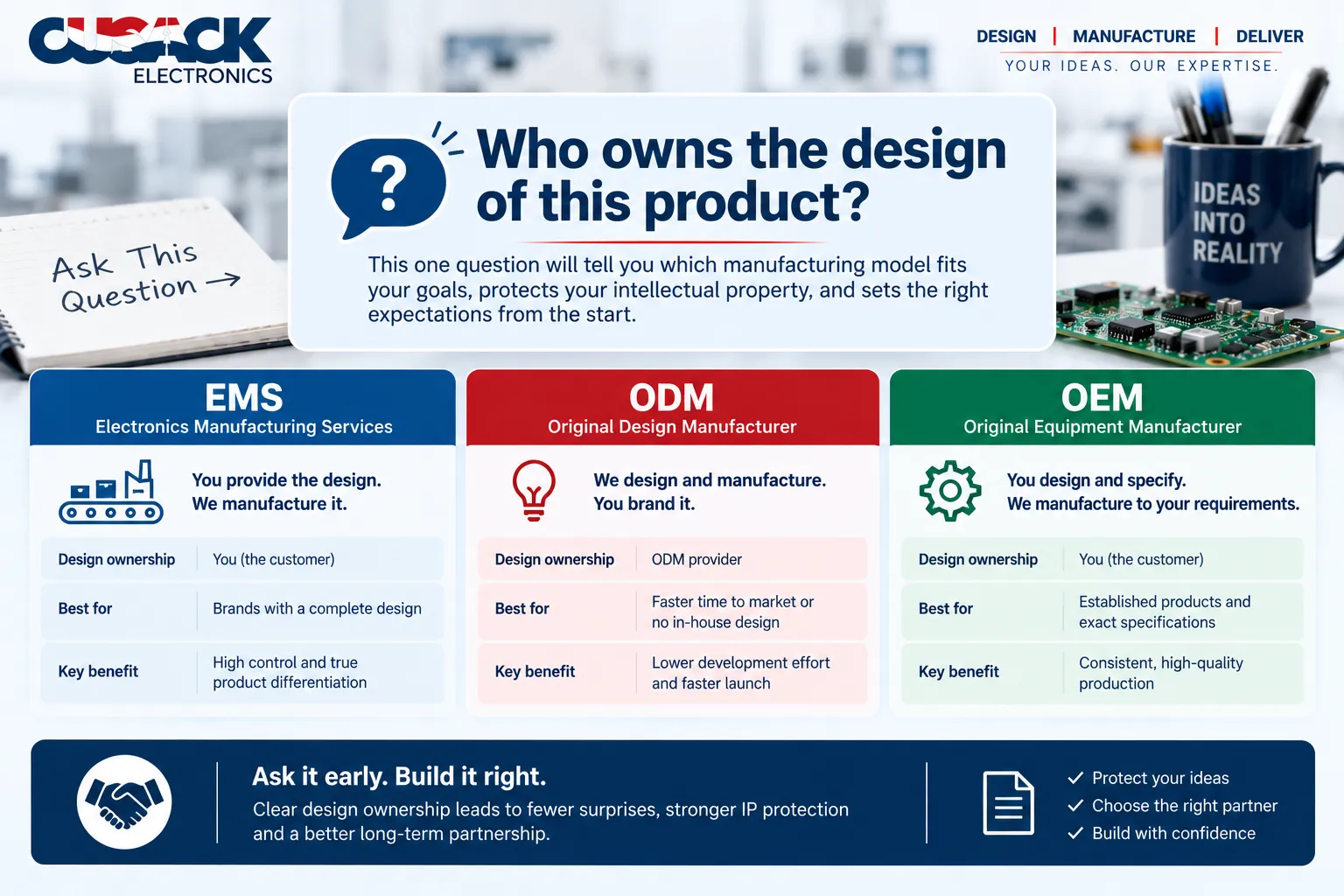
- The dividing line is who owns the design. With an EMS provider, you do. With an ODM, they do, and you are licensing or buying it.
- These are contract types, not company types. One factory can act as all three, depending on what you sign.
- The IP question decides everything else, including whether a competitor can buy your product from your own supplier next year.
EMS vs ODM vs OEM is the question I get most often from founders who have just started talking to factories. Someone has sent them a quote with an acronym on it, and the acronym quietly determines who owns their product.
Here is my flat opinion, before the definitions: the industry teaches these terms backwards. Articles present all three as vendor categories you choose between, like picking a supplier from a list.
They are not vendor categories. They are descriptions of a relationship, and you are one half of it.
What Do EMS, OEM, and ODM Mean in Electronics?
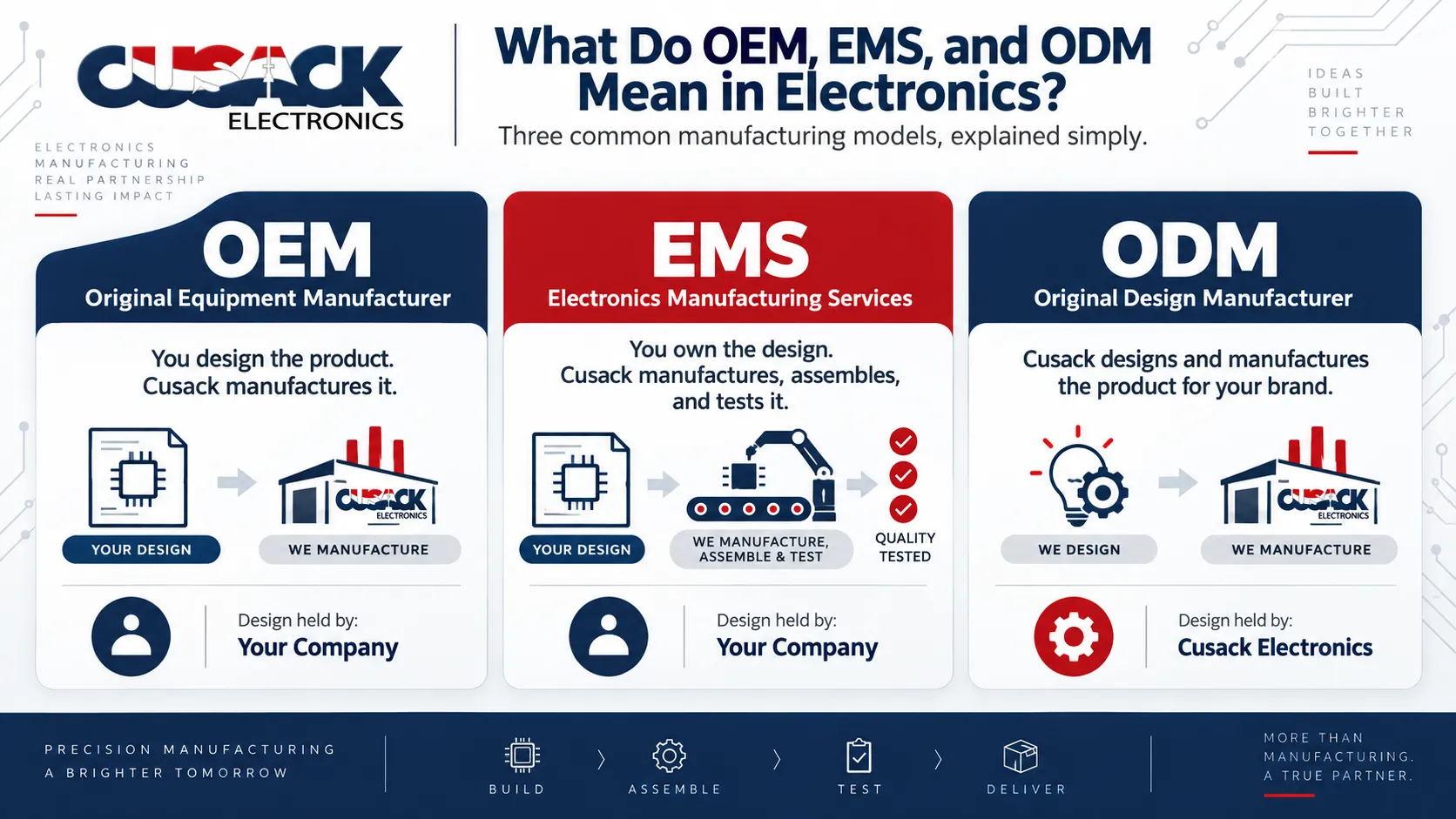
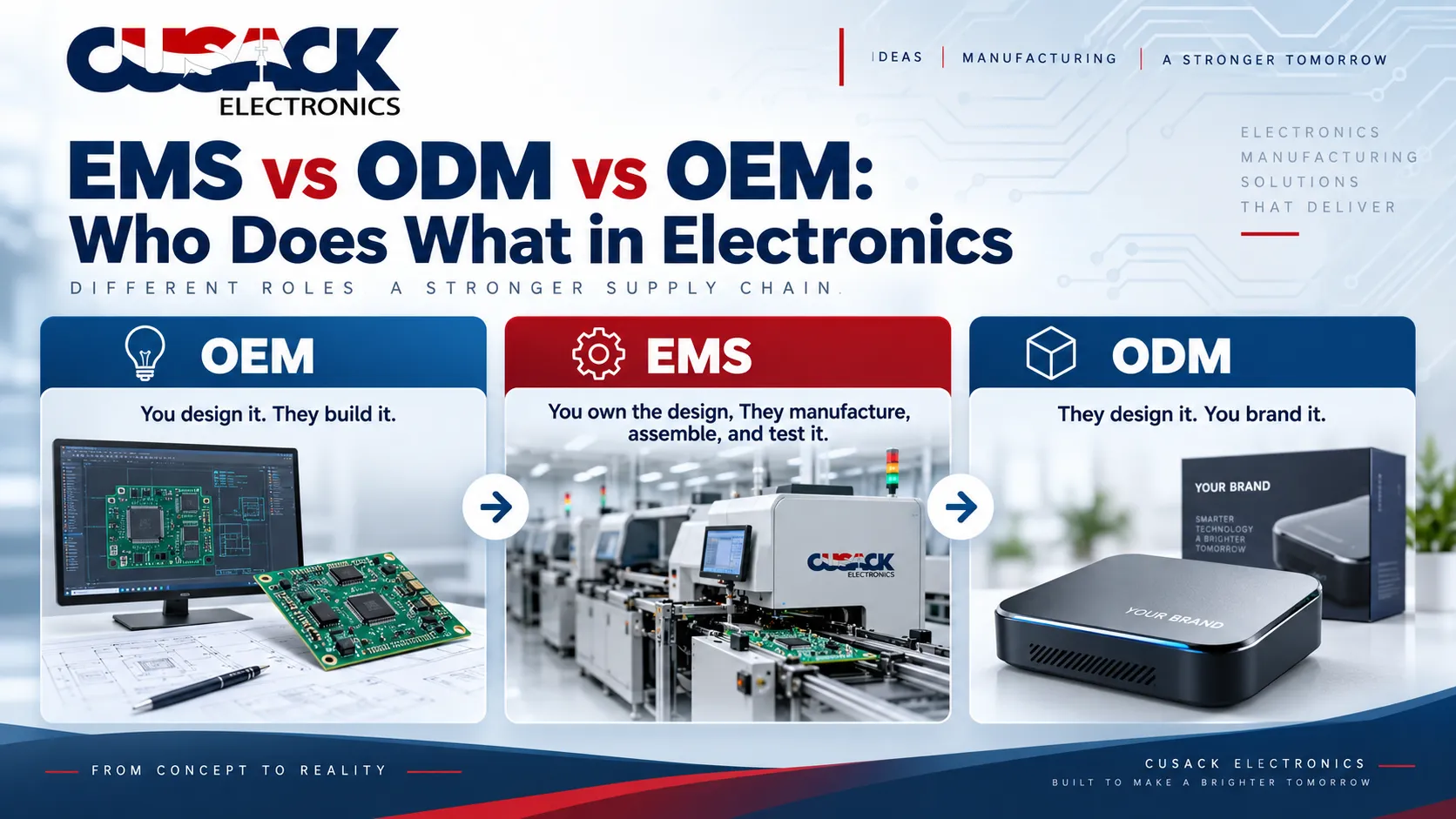
OEM, EMS, and ODM describe three different positions in electronics manufacturing: the company that owns and sells the product, the company hired to build someone else’s design, and the company that sells a design it already owns. The distinction that matters between them is design ownership.
Think of it like getting a house built. You can hire an architect and a builder separately, which is the OEM plus EMS arrangement. Or you can buy a house from a developer who already drew the plans and put up forty identical ones, which is the ODM arrangement.
Both get you a house. Only one of them gets you a house nobody else has.
What OEM Means
An original equipment manufacturer (OEM) is the company that owns a product, puts its brand on it, and sells it to the market. The OEM controls the design, the specifications, the software, and the customer relationship.
The name confuses people because it contains the word “manufacturer,” yet most OEMs manufacture nothing. Apple is an OEM. It designs the iPhone and owns every part of what the customer experiences, while the physical assembly happens elsewhere.
If you have a product idea, a brand, and customers, you are the OEM. That is true whether you have a factory or not.
What EMS Means
Electronic manufacturing services (EMS) is the category of outsourced work a specialist performs on the OEM’s behalf: assembly, component sourcing, testing, supply chain management, and often logistics and repair.
An EMS provider builds your design, under your brand, and hands it back. The design stays yours from start to finish. So does the bill of materials (BOM), the firmware, and every improvement made along the way.
This is the model behind most industrial, medical, and defense electronics. You can see the full scope of what that covers in this breakdown of electronic contract manufacturing.
What ODM Means
An original design manufacturer (ODM) is a company that designs and manufactures a product, then sells that design to brand owners who put their own label on it. Wikipedia’s ODM entry puts the distinction plainly: ODMs create their own intellectual property, while OEMs work to specifications supplied by someone else.
Walk into an electronics retailer and look at four brands of budget wireless earbuds. There is a good chance two of them came off the same ODM line, with different logos and different plastic.
That is not a scandal. It is the model working exactly as intended: speed and low cost, in exchange for a product that is not really yours.
EMS vs ODM vs OEM: What Is the Actual Difference?
The three models differ on six things that matter commercially. Everything else is detail.
| OEM | EMS | ODM | |
|---|---|---|---|
| Role | Owns and sells the product | Builds the OEM’s design | Designs and builds its own product for rebranding |
| Who designs it | The OEM, or a design partner it hires | The OEM supplies the design | The ODM |
| Who owns the IP | The OEM | The OEM (client) | The ODM |
| Product uniqueness | Whatever the OEM makes it | Whatever the OEM makes it | Shared with every other buyer of that design |
| Speed to market | Slowest, building from zero | Moderate, design plus build time | Fastest, the design already exists |
| Unit cost at low volume | Highest | Moderate to high | Lowest |
| Best fit | Any company with its own product | Custom hardware, regulated industries | Commodity products, fast market entry |
Read that table down the IP row and the rest of the decision usually answers itself.
An OEM working with an EMS provider keeps everything and pays for the privilege in time and engineering effort. An OEM buying from an ODM saves both and gives up exclusivity.
OEM vs ODM: Who Designs the Product?
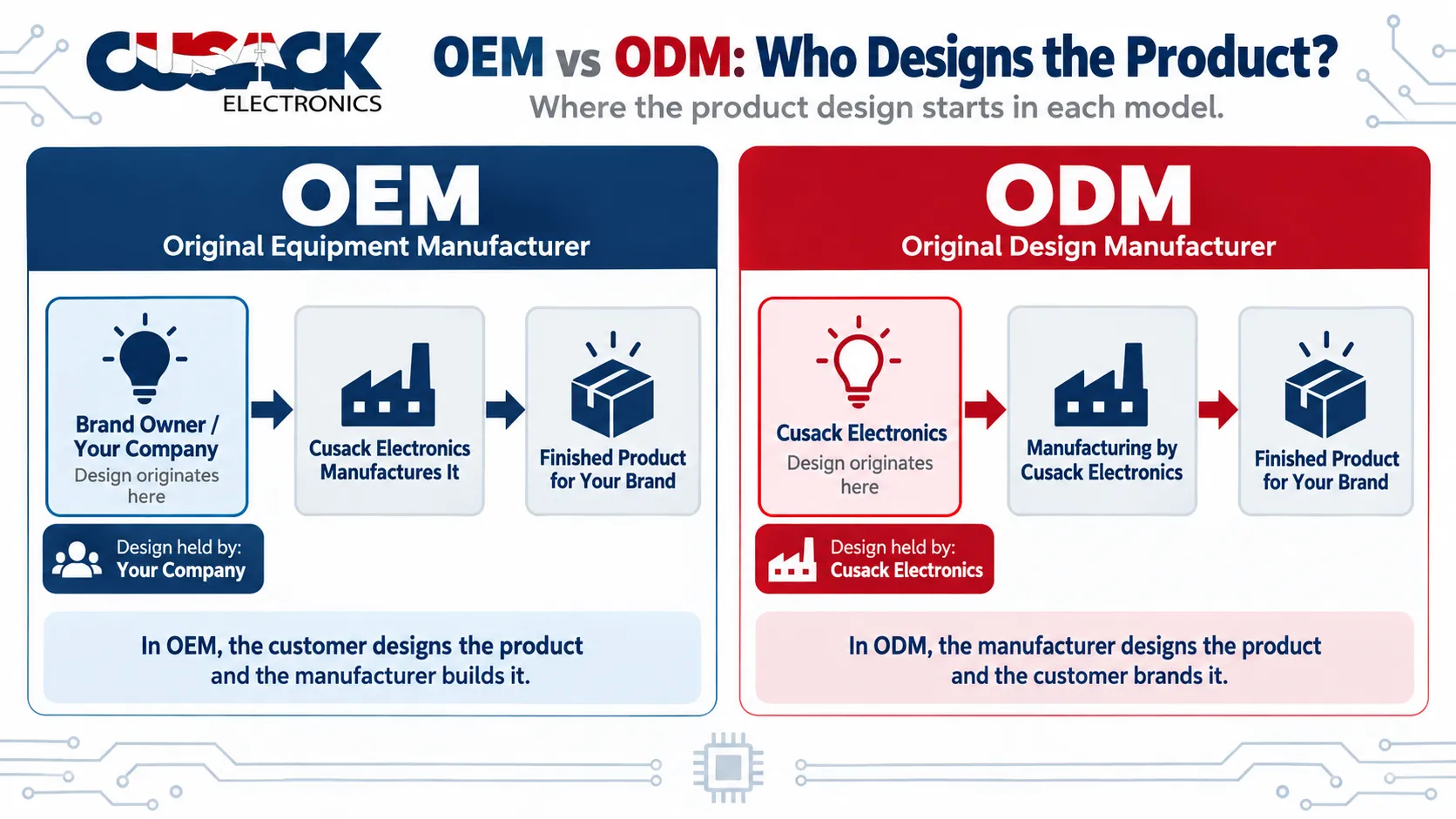
The OEM vs ODM question comes down to where the design originates and who holds the rights to it afterward.
Under the OEM model, the design starts with you. You may hire an outside product designer or engineering firm to draw it, but the output belongs to you, and the factory receives it as an instruction.
Under the ODM model, the design starts with the factory. It has already engineered a product, tooled for it, and certified it. You choose from what exists, ask for changes within limits, and attach your brand.
The practical difference shows up when you want something changed. An OEM changes its own product by issuing a revision. An ODM customer requests a change and finds out whether the ODM considers it worth doing for one customer.
That constraint is the real cost of ODM, and it is rarely the one people focus on during the quote stage.
EMS vs OEM: Why Do Brand Owners Outsource at All?
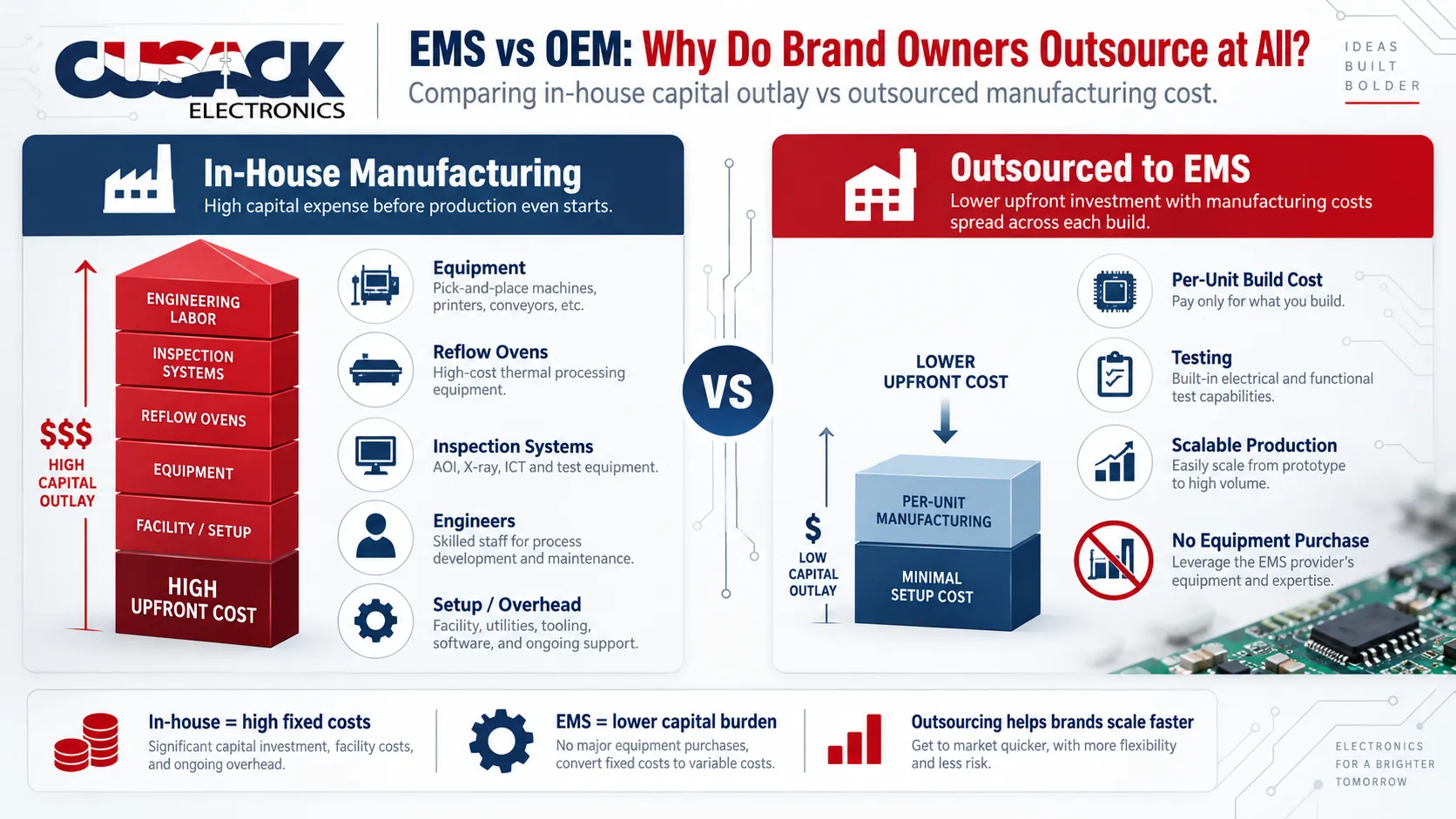
EMS vs OEM is not really a comparison, and this trips up a lot of people. An OEM is a customer. An EMS provider is a supplier. They sit on opposite sides of the same purchase order rather than competing for the same job.
The reason OEMs outsource is economic. Building an in-house assembly line means placement equipment, reflow ovens, inspection systems, and the engineers to run all three, before a single unit ships.
Outsourcing converts that capital expense into a per-unit cost. It also buys access to supply chain management, test engineering, and certifications that would take years to build internally.
The scale of that shift is visible in the market data.
Contract manufacturing took 71.93% of US electronics manufacturing services revenue in 2025, according to Mordor Intelligence.
That same report, updated in July 2026, has the ODM segment growing fastest of the three business models, at a projected 9.97% compound annual rate through 2031.
What an OEM gives up is direct control of the floor. You cannot walk downstairs and see the line. That is a real tradeoff, and it is why supplier selection matters more in this model than in any other.
Contract Manufacturer vs OEM: Is a CM the Same as an EMS Provider?
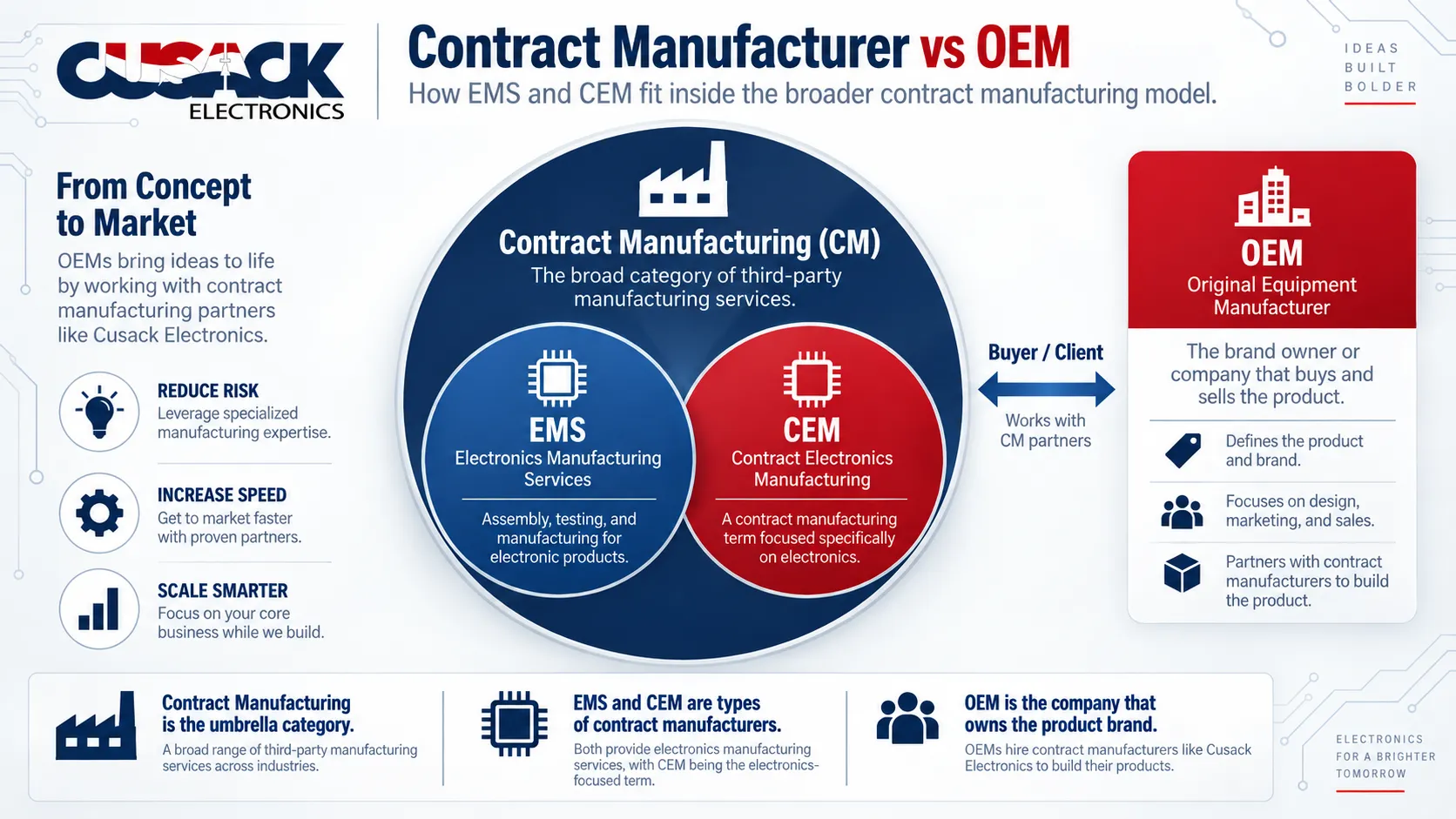
A contract manufacturer is any company that builds products to another company’s specification, in any industry. An EMS provider is a contract manufacturer that specializes in electronics.
So every EMS provider is a contract manufacturer. Not every contract manufacturer is an EMS provider. A shop injection-molding plastic housings is a contract manufacturer too.
The contract manufacturer vs OEM comparison has the same shape as EMS vs OEM. One is the buyer, one is the supplier, and confusing them makes procurement conversations harder than they need to be.
You will also meet CEM, for contract electronics manufacturer, which is used interchangeably with EMS. And JDM, joint design manufacturing, where you and the factory co-develop a product and negotiate who owns which parts of it.
JDM is worth knowing about because it is the honest middle ground between EMS and ODM. It is also where IP agreements get complicated fastest.
Who Owns the Intellectual Property in Each Model?
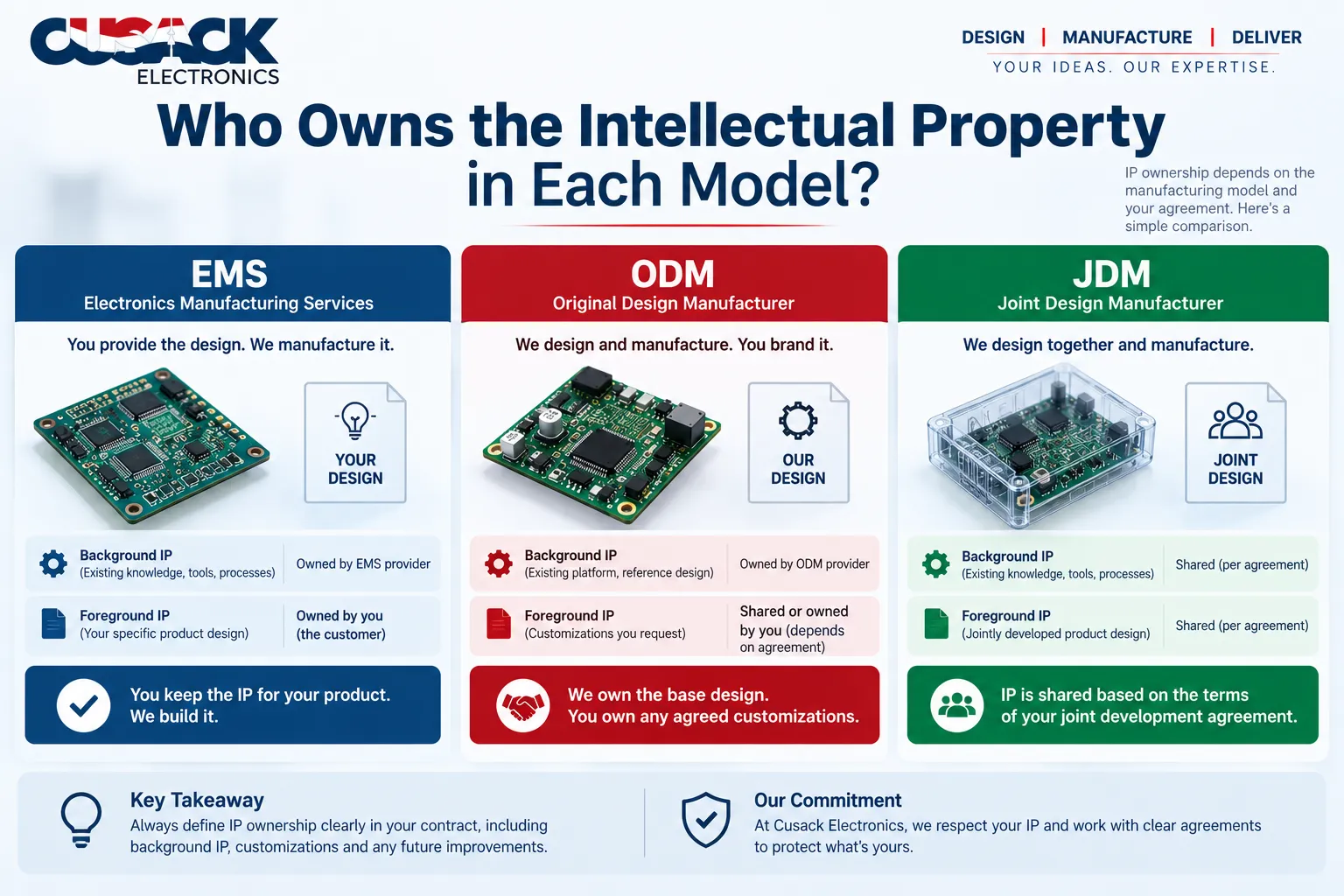
Intellectual property (IP) ownership is the one difference you cannot renegotiate later from a position of strength, which is why I treat it as the first question rather than the last.
- OEM plus EMS: you own the design, the BOM, the firmware, and the test specification. The EMS provider owns its own processes and tooling knowledge, not your product.
- ODM: the ODM owns the underlying design. You typically license it, sometimes with exclusivity for a period, often without.
- JDM: contested by default. Whatever you agreed in writing is what you have.
The World Intellectual Property Organization is blunt about the risk in supplier relationships. Its guidance notes that without clear contractual terms, suppliers may end up owning innovations they develop, gain access to trade secrets, and become competitors using your own IP.
WIPO’s practical fix is to separate background IP, meaning what each side brings to the table, from foreground IP, meaning what the collaboration produces. Custom and bespoke work is exactly where that line blurs, so it needs to be written down before work starts, not after.
The most famous illustration of this going wrong is public record. Apple relied on Samsung for components, Samsung later launched competing smartphones, and years of litigation followed.
You are unlikely to be Apple. The structural lesson holds at any size: your manufacturing partner has a commercial life of its own, and your contract is the only thing shaping how it intersects with yours.
EMS vs ODM: Which One Gives You a Product Worth Defending?
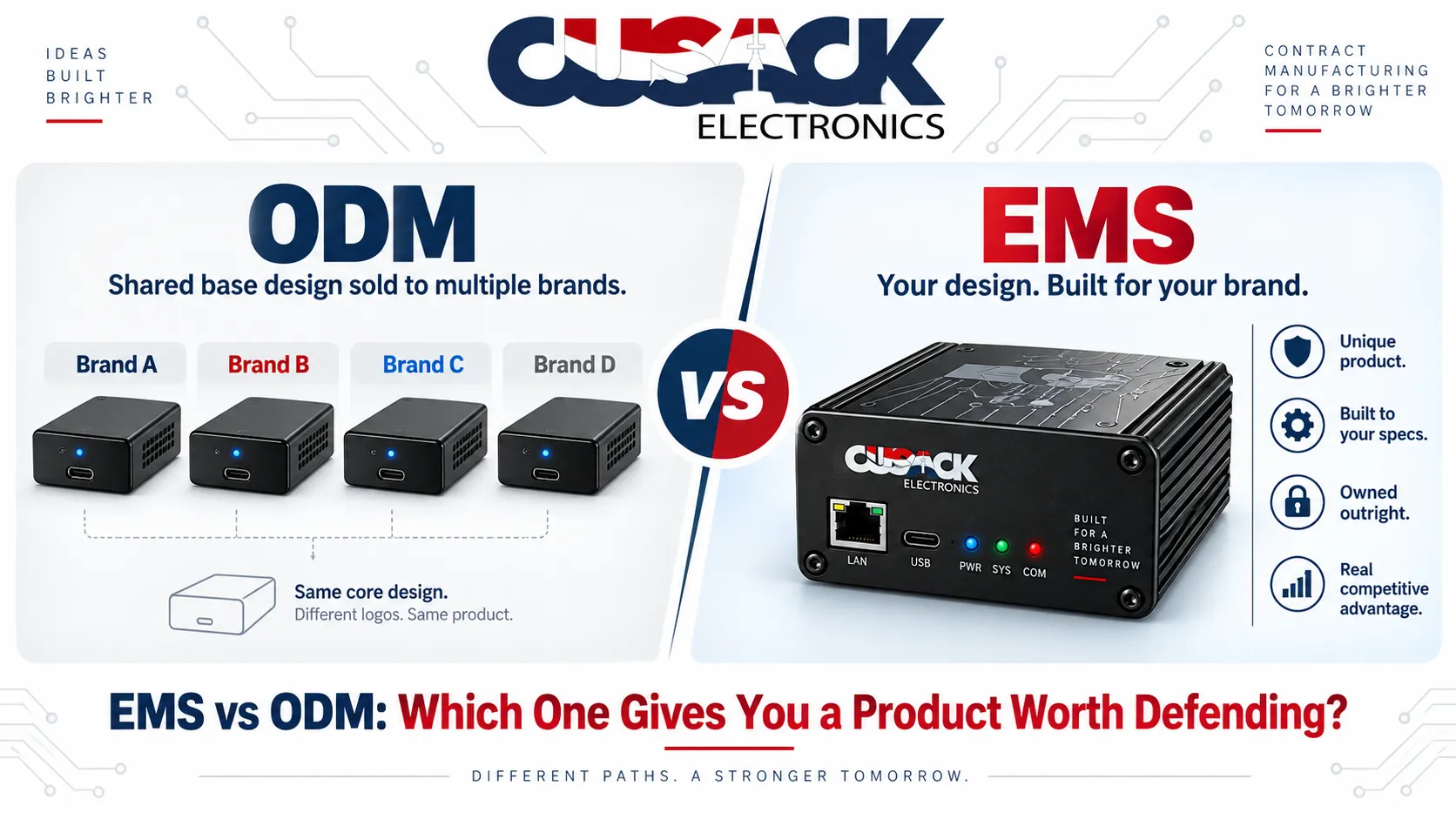
Choose EMS if the product itself is your competitive advantage. Choose ODM if speed to market matters more than owning something distinct.
That sounds simple, and in most cases it is. The complication is that founders routinely overestimate how differentiated their product needs to be, and then underestimate it once customers arrive.
An ODM product is hard to defend commercially. If your supplier sells the same design to three other brands, your only differentiators are price, marketing, and service.
An EMS-built product can be defended, because nobody else has the design. That advantage costs you engineering time up front and a higher unit cost until volume catches up.
Honest caveat: for genuinely commodity hardware, ODM is the correct answer and paying for custom design is waste. A USB hub does not need to be original.
Which Model Fits Your Product?
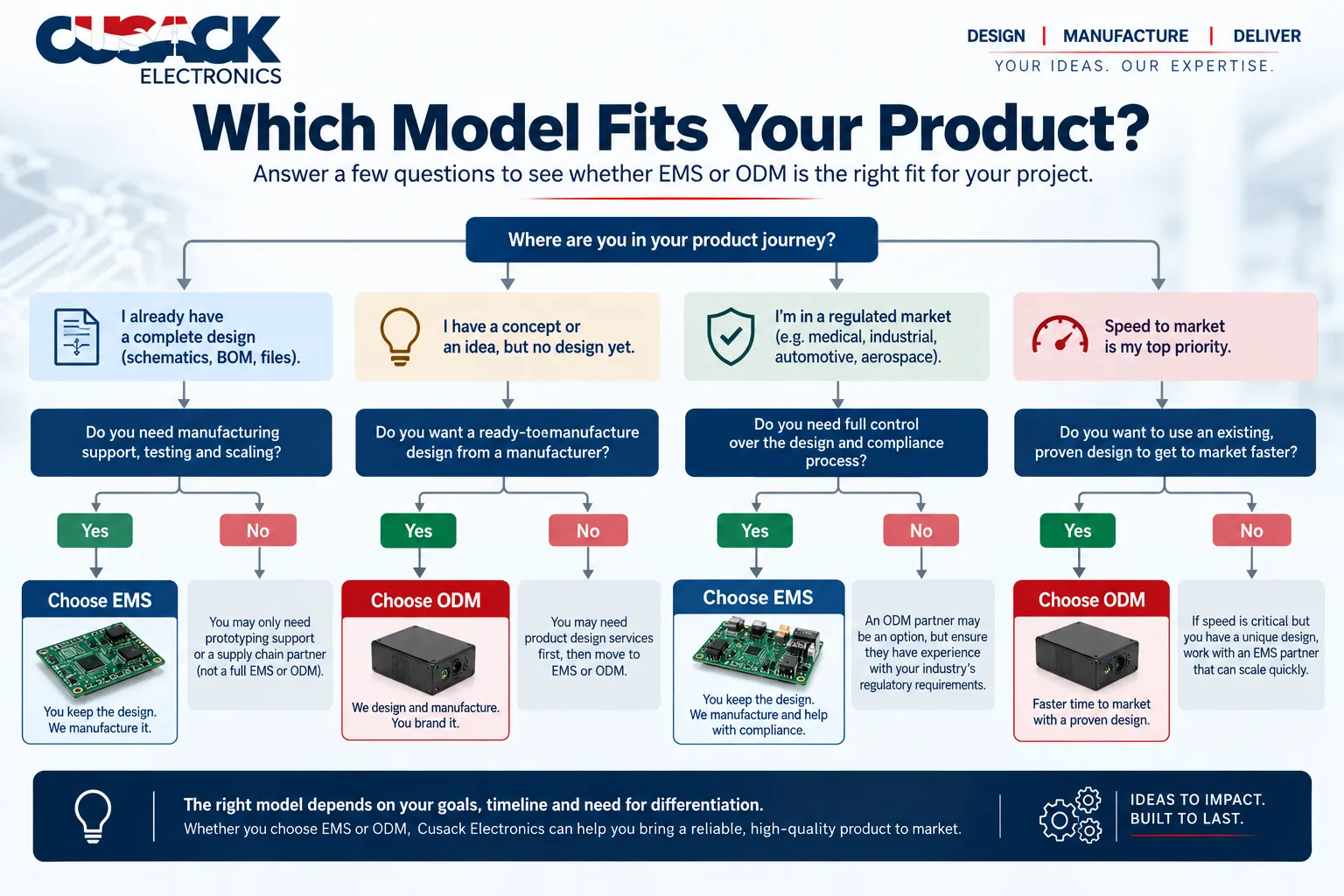
Use these triggers rather than a general preference.
- You have a working design and want it built. That is EMS. Send the design package and get a quote.
- You have a concept and no engineering team. Either hire a product designer and then go EMS, or go ODM and accept the shared design.
- You need certification in a regulated market. EMS, almost always. Medical and aerospace programs need traceability and documentation an ODM arrangement rarely provides at the level auditors want.
- You need to be selling in three months. ODM. Nothing else moves that fast.
- Your product is the business. EMS. Do not license the thing your company is built on.
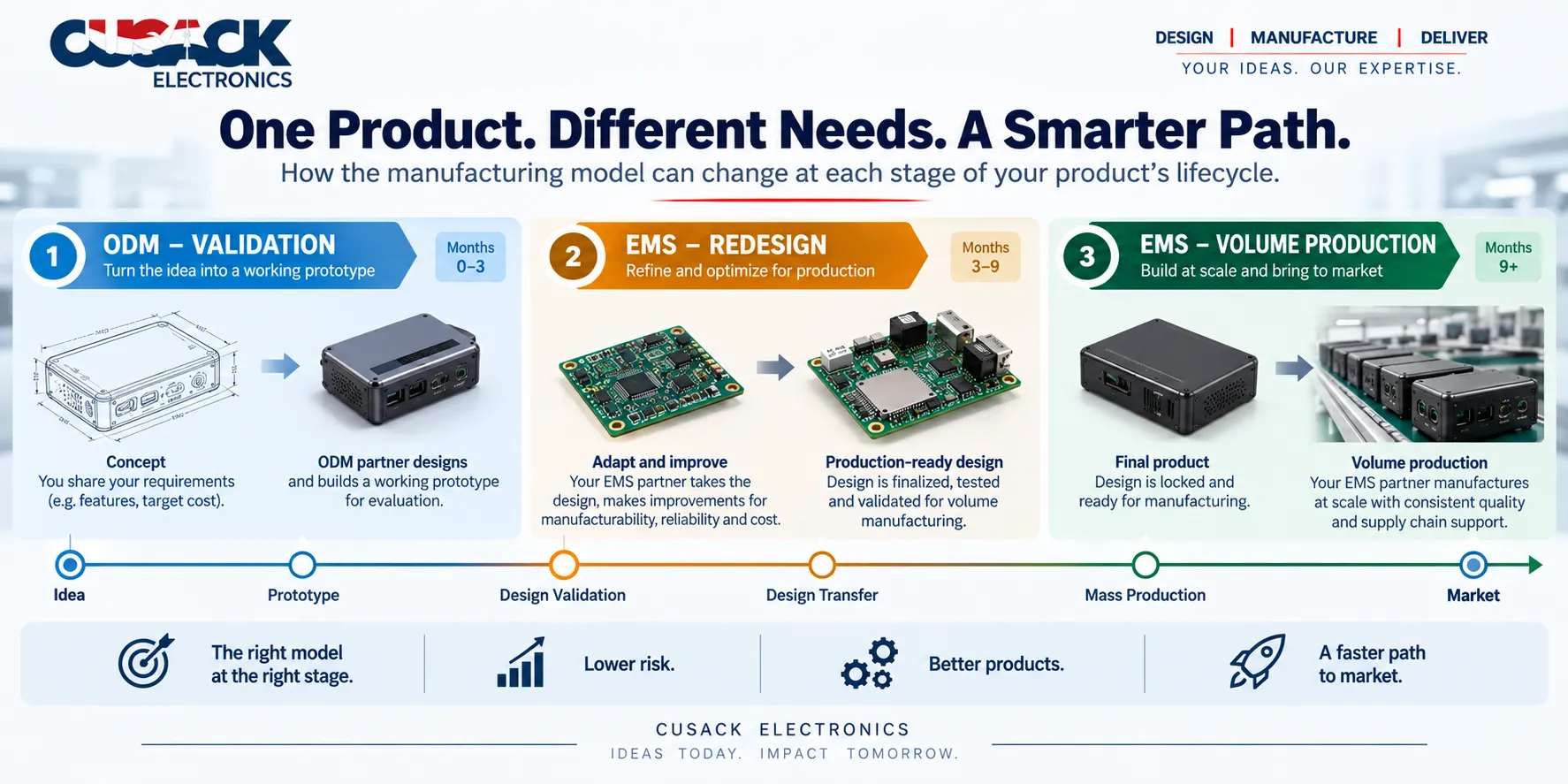
- You are testing whether a market exists. ODM to validate, then move to EMS once demand is proven and worth investing in.
Point six is how most successful hardware companies actually behave, and almost no article describes it. The models are stages in a product lifecycle, not a permanent identity.
The Mistake Hidden in the Question
Here is the part I wish someone had told me early: EMS, OEM, and ODM are not three boxes that companies live in permanently. They are three kinds of contract.
The same factory can act as an EMS provider for one customer and an ODM for another. It builds to your design on Monday and sells its own design on Tuesday. Nothing about the building changes, only the agreement.
This matters practically. When a supplier calls itself an ODM, that tells you what it prefers to sell, not what it is capable of doing.
Ask what the arrangement is on your specific program, in writing. “Are you an EMS or an ODM?” is a weaker question than “who owns the design files for this product when the program ends?”
One product can also move through several models across its product lifecycle. An ODM build validates demand, an EMS relationship carries the redesign, and a second EMS partner takes over at volume.
The Bottom Line
You are the OEM. An EMS provider builds what you designed and leaves ownership with you. An ODM sells you something it designed and keeps ownership itself.
Everything downstream, including cost, speed, differentiation, and the ability to switch suppliers later, follows from that one split.
If you remember nothing else, ask every prospective partner who owns the design files at the end of the program, and get the answer in the contract rather than the sales call.
Trying to work out which arrangement your product needs? Send me your design files or a short product brief and I will tell you straight which model fits, including when the answer is that you do not need a custom build at all. Request a quote here.
Frequently Asked Questions
What is the difference between EMS, OEM, and ODM?
An OEM owns and sells the product under its own brand. An EMS provider manufactures that product to the OEM’s design, leaving all intellectual property with the OEM. An ODM designs and manufactures its own product, then sells it to brand owners for rebranding, keeping the underlying design rights. Design ownership is the dividing line between all three.
Is EMS the same as contract manufacturing?
Electronic manufacturing services is a specialized form of contract manufacturing. Contract manufacturing covers any industry where one company builds to another’s specification, including plastics, metal, and textiles. EMS refers specifically to electronics, and usually includes engineering support, component sourcing, testing, and supply chain management alongside assembly.
Can an OEM work with an EMS provider?
Yes, and that is the standard arrangement in electronics. The OEM supplies the design, bill of materials, and test requirements. The EMS provider sources components, assembles, tests, and ships. The OEM keeps the brand, the customer relationship, and the intellectual property throughout, which is why the model suits companies whose product is their competitive advantage.
Does an ODM own the product design?
Yes. An original design manufacturer develops the design and retains the intellectual property in it. As a customer you are licensing or purchasing the right to sell that design under your brand, usually without exclusivity. This means the same underlying product can be sold by several competing brands at once, which limits how far you can differentiate.
Which is cheaper, EMS or ODM?
ODM is almost always cheaper per unit at launch, because the design, tooling, and certification costs are already spread across other customers. EMS carries higher up-front engineering cost and a higher unit price at low volume. The comparison shifts at scale, and it ignores the commercial value of owning something a competitor cannot buy.
What does OEM mean if the company does not manufacture anything?
The term is a historical artifact and it confuses almost everyone. Original equipment manufacturer now describes the company that owns, brands, and sells a product, whether or not it operates a factory. Most well-known electronics OEMs outsource all physical production. Ownership of the design and the brand, not the presence of a production line, defines the role.
What is a CEM, and how is it different from an EMS provider?
CEM stands for contract electronics manufacturer and it means the same thing as an EMS provider. The two labels are used interchangeably across the industry. EMS is the more common term today because it signals a wider service range, covering design support, supply chain management, testing, and aftermarket services rather than assembly alone.
How do I protect my intellectual property when outsourcing manufacturing?
Separate background IP, meaning what each side brings in, from foreground IP, meaning what the work creates, and define both in writing before production starts. Add confidentiality terms, clear tooling ownership, and an agreement on what happens to design files when the relationship ends. WIPO recommends settling these terms early rather than after a dispute begins.