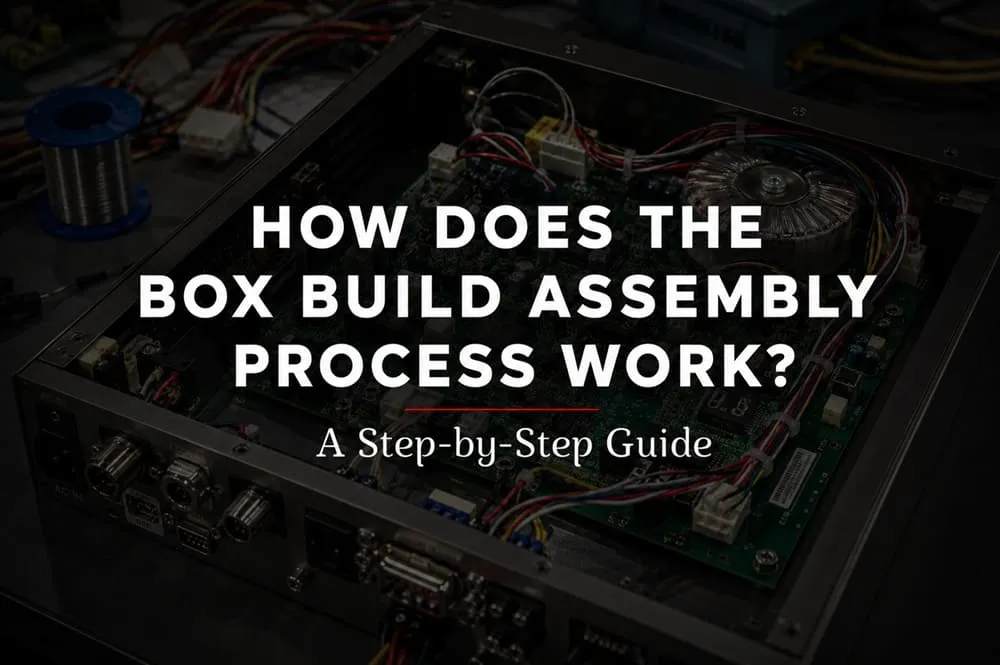
finished electronic product is rarely just a circuit board. Somewhere between a populated PCB and a shippable product, there is an enclosure, wiring, connectors, labels, and a testing step that confirms everything works together as one unit. That final stage is what the industry calls box build assembly, and for many OEMs it is the difference between receiving a pile of parts and receiving a product that is ready to ship straight to a customer.
If you are researching contract manufacturers or trying to understand where your product fits into a production process, this guide walks through exactly how box build assembly works, what it includes, and why more OEMs are moving toward turnkey box build partners instead of managing final assembly in-house.
What Is Box Build Assembly?
Box build assembly, sometimes called electromechanical assembly, is the process of taking manufactured components such as PCBs, wire harnesses, enclosures, and hardware, and assembling them into a complete, functional product. It is the step that turns individual manufactured parts into something a customer can actually plug in and use.
Unlike standard electronic PCB assembly, which focuses on populating a single circuit board, box build manufacturing covers the full physical product. This can include mounting boards inside enclosures, routing and connecting wire harnesses, installing switches, connectors, and displays, applying labels, and running final functional tests before the unit is packaged.
For companies that do not want to manage this final stage internally, working with a partner that offers box build assembly services means fewer vendors to coordinate and a single point of accountability for the finished product.
Why Box Build Assembly Matters
Many product failures do not happen at the component level. They happen during final assembly, when boards, wiring, and mechanical parts come together and something does not fit, connect, or perform as expected. A well-run box build assembly process is designed specifically to catch these issues before a product reaches the customer.
Box build assembly matters because it:
- Combines electrical, mechanical, and wiring work into one coordinated process
- Reduces the number of vendors an OEM has to manage
- Allows final functional testing on the complete product, not just individual parts
- Improves consistency and repeatability across production runs
- Shortens the path from manufactured components to a shippable product
For OEMs scaling from prototype to volume production, this final assembly stage is often where quality control decisions have the biggest impact on customer experience.
The Box Build Assembly Process, Step by Step
While every product is different, most box build assembly process workflows follow a similar sequence from incoming components to a finished, tested unit.
1. Component Receiving and Inspection
Before assembly begins, all incoming parts, PCBs, enclosures, hardware, cables, and purchased components, are inspected against the bill of materials. Catching a missing or incorrect part here is far cheaper than catching it mid-assembly.
2. Mechanical Assembly
The enclosure and internal mechanical structure come together first. This includes installing standoffs, mounting brackets, panels, and any machined or CNC-manufactured parts that form the product’s frame or housing.
3. PCB and Sub-Assembly Integration
Populated circuit boards are mounted into the enclosure, along with any sub-assemblies such as power supplies, displays, or modules. Board placement needs to account for airflow, connector access, and mechanical clearance planned during the original design phase.
4. Wiring and Cable Assembly
Wire harnesses and cable assemblies are routed, connected, and secured throughout the product. This step is often where a well-planned wire harness design pays off, since harnesses built to fit the enclosure route cleanly instead of forcing tight bends or awkward connector angles.
5. Fastening and Final Hardware Installation
Screws, panels, covers, and other hardware are installed to close and secure the unit. At this stage, technicians also confirm that the enclosure closes properly and that no wiring is pinched or stressed.
6. Functional Testing
The completed unit is powered on and tested against defined electrical and functional parameters. This is where box build manufacturing catches integration issues that would never show up when testing a bare PCB alone, since the full system, power, wiring, mechanical fit, and firmware, is now working together.
7. Labeling, Packaging, and Traceability
Serial numbers, compliance labels, and branding are applied, and the unit is packaged according to shipping requirements. Traceability records connect the finished unit back to component lots, test results, and build records.
What’s Included in Box Build Assembly Services
The scope of box build assembly services can vary depending on the manufacturer, but a comprehensive offering typically includes:
| Service Area | What It Covers |
| Mechanical assembly | Enclosure build, panel mounting, hardware installation |
| Electrical integration | PCB mounting, connector installation, sub-assembly wiring |
| Cable and harness assembly | Custom wire harnesses, cable routing, termination |
| Functional testing | Power-on testing, electrical verification, burn-in testing |
| Labeling and branding | Serial numbers, compliance labels, custom branding |
| Packaging | Product-specific packaging and kitting for shipment |
| Documentation | Traceability records, test reports, build documentation |
Knowing which of these are included upfront helps OEMs avoid surprises when comparing quotes between manufacturers.
Turnkey Box Build vs. Consignment Box Build
One of the first decisions an OEM has to make is whether to pursue a turnkey box build or a consignment model.
In a turnkey box build, the manufacturer sources all components, manages the supply chain, and delivers a complete finished product. This model shifts sourcing risk and vendor management to the manufacturer, which is why many OEMs prefer it, particularly when component sourcing has become unpredictable.
In a consignment box build, the OEM supplies some or all of the components, and the manufacturer handles assembly, integration, and testing. This can make sense for companies with existing supplier relationships or proprietary components they want to control directly.
Most contract manufacturers offer both, but a turnkey box build partner tends to be the better fit for OEMs who want to simplify their supply chain and reduce the number of vendors they manage.
Why Electromechanical Assembly Services Benefit From an Integrated Manufacturing Partner
Box build assembly rarely happens in isolation. It depends on decisions made earlier in the product lifecycle, including PCB layout, mechanical design, and wire harness planning. When these stages are handled by the same partner that performs final assembly, problems are far easier to catch early.
For example, a mechanical enclosure designed without considering wire routing can force a harness into tight bends during final assembly. A PCB placed without connector access in mind can make final wiring unnecessarily difficult. This is why coordinating mechanical design services and electronic design services with the team that will eventually perform box build manufacturing tends to produce smoother, more predictable production runs.
Choosing a Box Build Assembly Partner
When evaluating electromechanical assembly services, OEMs should look for a few key capabilities:
- In-house PCB assembly, so boards and final assembly are handled under one roof
- Mechanical and CNC capabilities for enclosures, brackets, and custom hardware
- Wire harness and cable assembly expertise
- Functional testing procedures tailored to your product
- Clear traceability and documentation practices
- Flexibility to support both prototype runs and volume production
- Willingness to support turnkey sourcing when needed
A partner with all of these capabilities under one roof, rather than split across multiple vendors, generally means fewer handoffs, fewer miscommunications, and a shorter path from finished components to a shippable product.
Final Thoughts
Box build assembly is where all the individual pieces of a product, boards, wiring, enclosures, and hardware, finally come together as one working unit. It is also where design decisions made months earlier either pay off or create problems. OEMs that plan for final assembly early, and choose a manufacturing partner capable of handling PCB assembly, mechanical work, wiring, and integration together, tend to see smoother production runs and fewer late-stage surprises.
Whether you are moving a new product from prototype to production or looking to simplify an existing supply chain, understanding how the box build assembly process works is the first step toward choosing the right manufacturing partner for your next build.