Picture two companies launching the same product. One hands their manufacturer a bill of materials and lets them handle everything — sourcing, assembly, testing. The other buys every component themselves and ships boxes of parts to their assembly partner. Same end product, completely different process. That’s the core of the turnkey PCB assembly vs consignment PCB assembly decision, and getting it right affects your cost, timeline, and risk from day one.
This guide breaks down both models so you can decide which fits your project.
What Is Turnkey PCB Assembly?
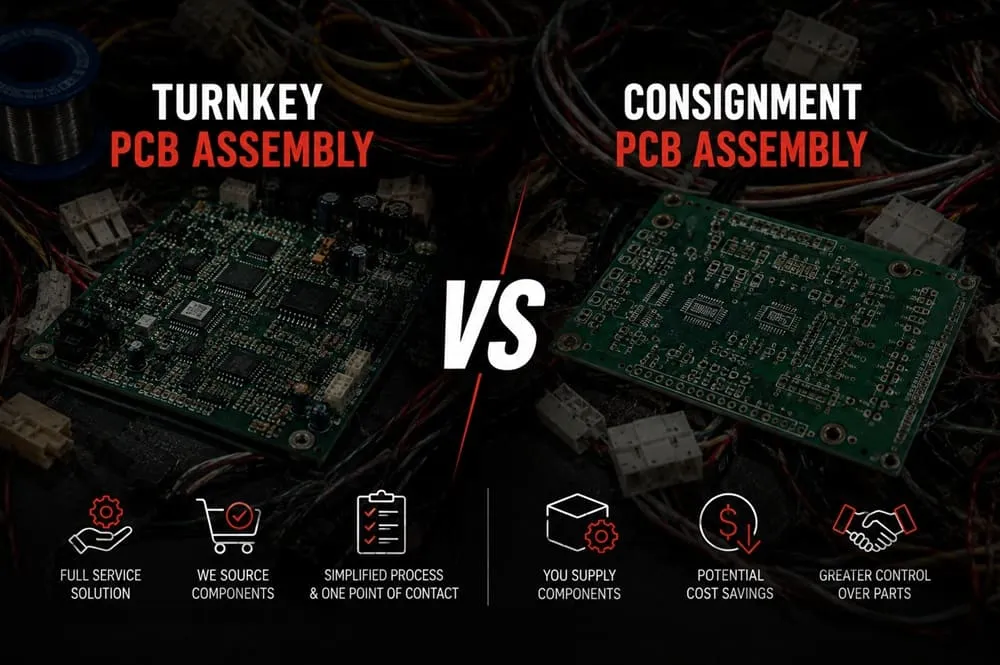
What is turnkey PCB assembly? It’s a model where your manufacturer handles the entire process — sourcing every component, assembling the board, and delivering a finished product. You provide the design files and bill of materials; the manufacturer takes care of the rest.
Full turnkey PCB assembly means 100% of components are sourced and procured by the manufacturer, giving you a single point of accountability for the whole build.
Pros of Turnkey Assembly
- One point of contact for sourcing, assembly, and quality
- Manufacturer’s supplier relationships often mean better pricing and availability
- Less coordination and logistics work on your end
- Faster turnaround since there’s no waiting on your shipped components
Cons of Turnkey Assembly
- Typically higher per-component cost, since the manufacturer marks up sourced parts
- Less direct control over which specific suppliers are used
- Requires trust in the manufacturer’s sourcing and quality process
What Is Consignment PCB Assembly?
In consignment PCB assembly, you source and supply the components yourself, shipping them directly to the manufacturer, who then handles only the assembly, soldering, and testing.
Pros of Consignment Assembly
- More control over exact component brands and suppliers
- Potential cost savings if you already have strong supplier pricing or existing inventory
- Useful when you have excess stock or negotiated rates on specific parts
Cons of Consignment Assembly
- You’re responsible for sourcing, shortages, and shipping components on time
- Any missing or incorrect parts can delay the entire production run
- More coordination overhead, especially with multiple suppliers
Turnkey vs Consignment PCB Assembly: Side-by-Side Comparison
| Factor | Turnkey PCB Assembly | Consignment PCB Assembly |
| Component sourcing | Handled by manufacturer | Handled by you |
| Coordination effort | Low | High |
| Cost per component | Higher (includes markup) | Lower (if you have good pricing) |
| Risk of shortages/delays | Lower, manufacturer manages it | Higher, falls on your team |
| Best for | Startups, new products, limited internal resources | Companies with existing supplier relationships or inventory |
| Accountability | Single point (manufacturer) | Split between you and manufacturer |
Is There a Middle Ground? Partial Turnkey Assembly
Not every project fits neatly into one category. Some manufacturers offer a hybrid approach where they source most components, while you supply a few specific parts — perhaps something proprietary, already in inventory, or sourced through a preferred supplier. This middle path can combine the lower coordination burden of full turnkey PCB assembly with the cost control of sourcing select components yourself.
Which One Is Right for You?
The right choice in the turnkey PCB assembly vs consignment PCB assembly decision usually comes down to a few questions:
Choose turnkey assembly if:
- You want a single point of accountability for your whole build
- Your team doesn’t have dedicated sourcing or procurement resources
- You’re launching a new product and want to minimize coordination risk
- Speed to market matters more than shaving cost on individual components
Choose consignment assembly if:
- You already have strong supplier relationships or negotiated pricing
- You have existing component inventory you want to use
- Your team has the bandwidth to manage sourcing, timing, and shipping
- You need tight control over specific component brands for compliance or design reasons
For most companies — especially those without an internal procurement team — turnkey PCB assembly removes a significant amount of risk and complexity from the process. It also pairs naturally with a manufacturer that offers full PCB assembly services alongside design support, since sourcing decisions can be reviewed against your design early rather than after components have already been purchased.
Real-World Scenarios
Sometimes the decision is easier to see through examples:
- A hardware startup launching its first product with no in-house procurement team is usually better served by turnkey PCB assembly — the manufacturer’s sourcing network reduces risk during a critical launch window.
- An established company with a dedicated supply chain team and existing volume pricing on key components may save money with consignment assembly, since they can leverage relationships the manufacturer doesn’t have.
- A company using one proprietary or custom-sourced component alongside standard parts is a strong candidate for partial turnkey assembly — letting the manufacturer source everything else while you supply the one specialized part.
- A business in a highly regulated industry, where specific certified suppliers are required by compliance standards, often needs the added control of consignment or partial turnkey assembly to guarantee traceability.
Mapping your own situation against these scenarios usually makes the right choice clear fairly quickly.
A Note on Component Shortages
One factor worth weighing heavily: component shortages have become common across the electronics industry in recent years. With turnkey PCB assembly, your manufacturer typically has broader supplier networks and more visibility into availability issues before they become production delays. With consignment PCB assembly, that risk sits with you — if a part you sourced becomes delayed or unavailable, the production schedule stops until you resolve it.
Final Thoughts
There’s no universally “better” option in the turnkey PCB assembly vs consignment PCB assembly debate — it depends on your team’s resources, your supplier relationships, and how much control versus convenience you’re looking for. Many companies start with full turnkey assembly for new products, then shift toward consignment or partial turnkey once they’ve built strong supplier relationships of their own.
If you’re not sure which approach fits your project, talk to our team — we can walk through your design and volume to recommend the best path forward.